EMI CLASSICS TO ISSUE SIX OPERAS FROM THE METROPOLITAN OPERA'S ACCLAIMED
LIVE IN HD SERIES JUST IN TIME FOR THE NEW 'THEATRE BROADCAST' SEASON
Canadian release date: September 16, 2008
Engelbert Humperdinck: Hansel and Gretel
Giuseppe Verdi: Macbeth
Tan Dun: The First Emperor (World Premiere)
Giacomo Puccini: La Bohˆ®me
Benjamin Britten: Peter Grimes
Giacomo Puccini: Manon Lescaut
EMI Classics will issue six operas on DVD produced by the Metropolitan Opera for its highly acclaimed series The Met: Live in HD. This September, five productions from the Met's 2007-08 season will be released, as well as the 2006 world premiere production of Tan Dun's The First Emperor. The releases further extend the reach of The Met: Live in HD, the groundbreaking series of live operas transmitted to movie theatres, arts centres and universities all over the world; next season, the series will expand to reach 800 venues and 28 countries. The 2008/2009 Met Live HD series broadcasts in Canada commence on September 22nd (for more information on this go to: http://www.metoperafamily.org/metopera/news/press/detail.aspx?id=3810).
The operas include new productions of Hansel and Gretel, Macbeth, and Peter Grimes; the world premiere production of The First Emperor; La Bohˆ®me and Manon Lescaut.
The Met's critically acclaimed high-definition productions are directed by top creative talent from the film and television fields, who capture the intensity of live opera using cutting-edge technology, including vertical and dolly-tracked robotic cameras. During the intermissions, the cameras go backstage for interviews with performers and others involved in the production. The shows are hosted by such stars as Renˆ©e Fleming, Natalie Dessay, and the late Beverly Sills.
The audio is mixed with Dolby surround-sound encoding supervised by DTS. Each accompanying DVD booklet has notes and a synopsis in English. Each title also includes an electronic booklet in PDF form, which can be accessed from any computer equipped with a DVD-ROM drive and Adobe Acrobat 6.0. This booklet contains notes and cast biographies in English, French, and German.
Engelbert Humperdinck: Hansel and Gretel
New Production
Sung in English with optional subtitles in French, German, Italian, and Spanish
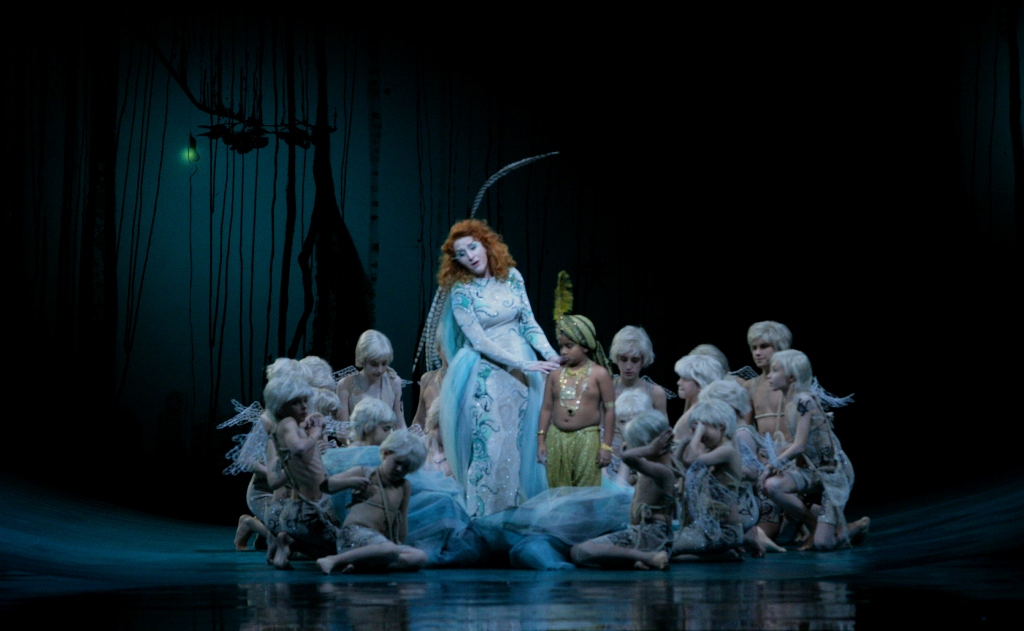
The combination of the timeless Brothers Grimm fairy tale, Humperdinck's enchanting score, Richard Jones's intriguing new production, and a new English-language translation by David Pountney make this Hansel and Gretel appealing to audiences of all ages.
Hansel and Gretel are charmingly performed by Alice Coote and Christine Schˆ§fer. The children's parents are played by Rosalind Plowright and Alan Held. The Witch, written for mezzo-soprano, is sometimes sung by a tenor, in this production Philip Langridge in what was described by The New York Times as "a casting coup".
"In the pit, the brilliant young Russian conductor Vladimir Jurowski ’Ķ. conveys the lyricism of this 1893 opera while never letting us forget that Humperdinck was a Wagner protˆ©gˆ© who filled this score with rich chromatic harmony and thick, dark orchestral colorings. ’Ķ [Mr. Jurowski] conducts a resonant and radiant performance." (The New York Times)
Describing the high-definition production shown in cinemas, The New York Times said, "All three acts are set in strange kitchens: the drab 1950s kitchen of Hansel and Gretel's impoverished family; an Expressionistic kitchen-dining room with leafy wallpaper to symbolize the forest where the siblings become lost; and an industrial-size, stainless-steel kitchen where the Witch bakes her child victims into gingerbread. ’Ķ The sophisticated camera work ’Ķ was especially impressive ’Ķ Subtleties of acting that barely register in the house came through movingly on screen."
In 1923, Hansel and Gretel became the first complete opera to be broadcast on radio from Covent Garden; eight years later it was the first to be broadcast from the Met.
Backstage at the Met Bonus Material: Renˆ©e Fleming interviews the Met's Technical Director Joe Clark; Christine Schˆ§fer and Alice Coote are interviewed live during intermission; and the feature The World of John Macfarlane, shows how set and costume designer John Macfarlane brought Hansel and Gretel to life.
Giuseppe Verdi: Macbeth
New Production
Sung in Italian with optional subtitles in English, French, German, and Spanish
‰‡eljko LuŸçiŸá, Maria Guleghina, John Relyea, and Dimitri Pittas star in a new production of Verdi's haunting early operatic masterpiece. Longtime Met Music Director James Levine conducts.
This is the Met's first production in 20 years of the first of Verdi's three operas based on Shakespeare's plays. It is "a stylistically eclectic, grimly effective and, at times, intriguingly playful production" (The New York Times) by the English director Adrian Noble, in his Met debut. Noble, former Artistic Director of the Royal Shakespeare Company, and set and costume designer Mark Thompson "mixed modern and melodramatic elements into this nearly black-and-white, modern-dress staging." (The New York Times)
At the time of its composition, Verdi's Macbeth was unique. Not only was it considered both musically and dramatically bold, but it was the first opera that could truly be described as Shakespearean. It was the first that altered operatic conventions to serve the play rather than converting the play into traditional operatic formulas. The Met performs Verdi's revised 1865 Paris version, minus the ballet he was obligated to write for that production.
After 33 highly successful years in charge of the company's musical forces, a relationship unique in the musical world today, the Met's Music Director James Levine conducts Verdi's haunting score with the intensity that this chilling work demands: "[Levine] conducts "Macbeth" as a ’Ķ supreme musical drama. ’Ķ Without diminishing the architectonic shape of the work, he is keenly sensitive to the vocal needs of the cast, ready in an instant to adjust the pacing, to coax the singer and orchestra musicians into beautifully coordinated execution of a lyrical phrase. The orchestra sounded terrific. In ruminative passages the string tone was ’Ķ velvety and nuanced ’Ķ [but] when red-blooded Verdian orchestral sound was called for, Mr. Levine summoned plenty of it. " (The New York Times)
Backstage at the Met Bonus Material: Met General Manager Peter Gelb interviews Music Director James Levine; Zeljko LuŸçiŸá, Maria Guleghina (Macbeth and Lady Macbeth) and director Adrian Noble are also interviewed; and a video blog shot during the rehearsal process is also included.
Tan Dun: The First Emperor
Met Commission/New Production
Sung in English with optional subtitles in French, German, Italian, and Spanish
"A majestic imperial Chinese saga...[Domingo] sang with stamina and burnished power." New York Times
Legendary tenor Plˆ°cido Domingo stars in this visually stunning opera by Academy Award-winning composer Tan Dun (Crouching Tiger, Hidden Dragon) to a libretto by the composer and Ha Jin, based on Historical Records by Sima Qian (c.145’Äì85 BCE) and on Wei Lu's screenplay, The Emperor's Shadow. The opera was commissioned by the Met in the mid-1990s and the spectacular production, which premiered in December 2006, was one of the most highly anticipated cultural events of the season.
The opera tells of Emperor Qin's quest for a national anthem for his new country and his ill-fated decision to force his childhood friend, a talented composer, to write it. Tragedy results following the composer's love affair with the emperor's crippled daughter. As Emperor Qin, Plˆ°cido Domingo leads an all-star ensemble in this epic story, which is ideally suited to the opera stage.
The First Emperor combines the expressive power of traditional ancient Chinese singing with the long musical lines of Italian opera. This juxtaposition of musical cultures illustrates Tan Dun's musical style, which merges East and West and ancient and modern sensibilities.
One of just six composers to conduct their own works at the Met, Tan Dun led all the performances of the first run of the opera.
The production was directed by the revered Chinese filmmaker Zhang Yimou (Hero, Raise the Red Lantern, and director of the opening and closing ceremonies of the Beijing Olympics), who worked closely with Tan Dun while he composed the music.
The costumes were designed by Emi Wada, who won an Oscar for her work in the 1986 movie Ran. Over the course of a year and a half, Wada designed more than 600 striking and colourful costumes.
Backstage at the Met Bonus Material: Beverly Sills interviews Plˆ°cido Domingo, and a documentary film, Tan Dun's The First Emperor: In Rehearsal at the Met gives a behind-the-scenes look at the creative process.
Giacomo Puccini: Manon Lescaut
Sung in Italian with optional subtitles in English, French, German and Spanish
The performance captured on this DVD marks the first on the Met stage in 18 years of the Met's classic production of Puccini's Manon Lescaut. Finnish soprano Karita Mattila performs the title role, conducted by James Levine. Chevalier des Grieux is played by Marcello Giordani, Manon's brother by Dwayne Croft and Geronte by Dale Travis.
Manon Lescaut, the French tale of a beautiful young woman destroyed by her conflicting desires for love and luxury, was Puccini's first successful opera and the work that thrust him into the international spotlight as Italy's foremost opera composer.
Mattila's performance is a career highlight, with The New York Times calling her interpretation "riveting". The soprano waited for her voice to gain maturity and richness before singing her first Manon Lescaut in 1999, when she was nearly 40. She now returns to the work, attracting James Levine to conduct it for the first time since 1981.
After 33 highly successful years in charge of the company's musical forces, a relationship unique in the musical world today, the Met's Music Director James Levine leads a fresh and intelligent performance. "Conceptually Mr. Levine seemed on the same page with his star soprano. He drew Italianate ardor and pliant lyricism from the Met orchestra yet conveyed the rhythmic intricacy, harmonic boldness and symphonic sweep of the music as well." (The New York Times)
"Ever willowy and ever inventive, Karita Mattila enacted the heroine's progress from gawky innocent to greedy charmer to tragic victim brilliantly. ’Ķ Marcello Giordani partnered her as golden-age Des Grieux, handsome and urgent in demeanour, suave in passages of introspection, glorious in outbursts of passion. ’Ķ The strong secondary cast included Dwayne Croft, a gratifyingly crafty Lescaut, Dale Travis, a stern Geronte who resisted buffo temptation, and Sean Panikkar, a sweet and sprightly Edmondo. ’Ķ [Levine] let the melodies soar." (Financial Times)
Backstage at the Met Bonus Material: Renˆ©e Fleming interviews Karita Mattila, Marcello Giordani, animal trainers and handlers Nancy and Paul Novograd, and the Met's Technical Director Joe Clark.
Benjamin Britten: Peter Grimes
New Production
ICPN: 5099921741494 (1 DVD)
Sung in English with optional subtitles in English, French, German, Italian, and Spanish
"The more vicious the society, the more vicious the individual." - Benjamin Britten, commenting on Peter Grimes after its premiere in 1945
Anthony Dean Griffey and Patricia Racette are gripping in this new Met production of Benjamin Britten's most celebrated opera, Peter Grimes. The multi-award-winning director is John Doyle, whose production of Sweeney Todd won the 2006 Tony Award® for Best Direction of a Musical. The Financial Times described Doyle's direction of Peter Grimes as "an impeccable fusion of music and drama."
Peter Grimes, Britten's haunting seaside tale and his second opera, is widely regarded as one of the masterpieces of postwar opera, and its premiere 63 years ago marked a turning point in the history of British opera. This "true operatic masterpiece of the 20th century" (The New York Times) is the first opera by an English composer to enter and remain in the international repertory. Peter Grimes is based on a poem entitled The Borough, by turn-of-the-19th-century writer George Crabbe set in an isolated English fishing village in the 1830s.
Much of the emotional drive of the opera comes from the four Sea Interludes ’Äì calm, storm, at dawn and by moonlight. Among the most brilliantly evocative music that Britten ever wrote, they help to establish the constant, overpowering presence of the sea as the opera's dominant force.
Anthony Dean Griffey is "the leading Peter Grimes today" (Washington Post), and [his] "fascinating performance should not be missed" (Associated Press). Patricia Racette, as Ellen Orford, the schoolmistress who tries and fails to rescue Grimes from his anger and self-pity, is "sublime" (The Guardian). "The voice was vibrant, liquid, and exciting" (New York Sun). "A powerful cast, led by tenor Anthony Dean Griffey," writes the San Francisco Chronicle, "found the pathos and terror in Britten's score."
Donald Runnicles, Music Director of the San Francisco Opera, "drew an inspired performance from the Met Orchestra, full of passion and commitment yet free of bombast. Without slackening the dramatic tension, he found ways of drawing out both the music's austere lyricism and its violent extremes." (Boston Globe)
Backstage at the Met Bonus Material: Natalie Dessay interviews Anthony Dean Griffey and Patricia Racette (Peter Grimes and Ellen Orford), conductor Donald Runnicles, chorus master Donald Palumbo, and members of the creative team, including director John Doyle, costume designer Ann Hould-Ward, and set designer Scott Pask. There is also a live BBC segment from Benjamin Britten's hometown of Aldeburgh.
Giacomo Puccini: La Bohˆ®me
Sung in Italian with optional subtitles in English, French, German, and Spanish
Angela Gheorghiu and Ramˆ„n Vargas lead a magnificent cast in Franco Zeffirelli's sumptuous and iconic production of Puccini's timeless masterpiece La Bohˆ®me. "[It] just might be the best investment the Met ever made’Ķ Its magic shows no sign of diminishing." (Opera News Online)
Set in Paris around 1830, La Bohˆ®me depicts a love that blossoms between two young artists in a time that appears both bleak and turbulent that makes this story so very special.
Mimˆ¨ and Rodolfo, sung by Gheorghiu and Vargas, respectively, are charming as the young couple who fall in love. Ludovic Tˆ©zier and Ainhoa Arteta sing Marcello and Musetta.
Gheorghiu, one of the leading Puccini sopranos of our time, sings the role of Mimˆ¨ at the Met for the first time in twelve years. "[Gheorghiu] was superb as Mimˆ¨’Ķ distinctive and alluring. She sang with extraordinary precision, subtlety, control, nuance, and, above all, musicality" (New York Sun). "Ramˆ„n Vargas, as Rodolfo, produced a warm, buttery sound" (The New York Times). Conductor Nicola Luisotti is, "a man who knows what he is doing in this repertoire: the way he can control the orchestra to move with the singers' expressive tempo fluctuations is breathtaking, a quality which helps to show Puccini at his best" (musicalcriticism.com).
Franco Zeffirelli's stunning production is as beloved and magnificent today as the day it was first staged at the Metropolitan Opera more than 27 years ago. The April 5, 2008, broadcast of this production marked the 347th performance of Zeffirelli's La Bohˆ®me at the Met, making it the most performed production in the company's history.
Backstage at the Met Bonus Material: Renˆ©e Fleming interviews Angela Gheorghiu, Ramˆ„n Vargas and Met Technical Director Joe Clark, and a bonus feature, Zeffirelli at the Met, includes archival interviews and performance clips.
Labels: DVD, Metropolitan Opera, opera, puccini, verdi