|
|
|
[INDEX]
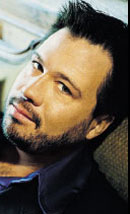 American
countertenor David Daniels (photo left) made his Carnegie Hall recital
debut on Nov. 23, 2002, in what was billed as the first countertenor solo
recital in the complex’s main 2,804-seat Stern Auditorium. As such this
was a historic event, marking mainstream acceptance of the countertenor
fach. American
countertenor David Daniels (photo left) made his Carnegie Hall recital
debut on Nov. 23, 2002, in what was billed as the first countertenor solo
recital in the complex’s main 2,804-seat Stern Auditorium. As such this
was a historic event, marking mainstream acceptance of the countertenor
fach.
The hall was packed with Daniels’ diverse fans, including early music
buffs and a large gay following (Daniels is one of the few openly gay
classical musicians). But cliques and claques are only part of his success
story. The Carnegie Hall subscription audience was also there in force,
equally intrigued and appreciative.
Artistically the evening was a triumph for Daniels, who displayed the
full range of his artistic, linguistic and expressive accomplishments.
The program opened with two Mozart lieder, An Chloë, K.524 and Abendempfindung,
K.523, both sung with good German diction and understated grace, yet with
sufficient volume to fill the large hall.
Four mélodies by Gabriel Fauré followed. Spleen, Op. 51, No. 3, Mandoline
and En sourdine from Cinq mélodies de Venise, Op. 58, and Clair de lune,
Op. 46, No. 2, revealed a wide range of colors, reminding us that Daniels
is more than just a great countertenor. He is a great singer, tout court,
equal to the finest singers in the so-called “normal” voice fachs.
Britten’s haunting, mock-medieval Canticle II: Abraham and Isaac, Op.
51, was a daring choice, with its vaguely pedophilic dialogue between
the Jewish patriarch and his submissive son. Daniels (who took the part
of Isaac) was joined by tenor Anthony Dean Griffey (Abraham). The house
lights were dramatically lowered for the passages in which the two blended
voices represented the Voice of God.
Fans of Daniels’ opera singing revelled in two arias from Handel’s Semele:
“Your tuneful Voice” which displayed the singer’s lovely lyrical middle
voice and exquisite embellishments; and the faster aria “Despair no more
shall wound me”, a welcome display of Daniels’ coloratura abilities.
After the intermission, Daniels performed the Carnegie Hall premiere of
American composer Theodore Morrison’s recent song cycle Chamber Music,
a setting of five pastoral-romantic poems by the young James Joyce. They
were modest, eminently accessible songs, in an idiom that hearkened back
to the English “cowflap” school of Quilter, Vaughan Williams, et al. Morrison
was present and took a bow.
The program concluded with five American folk songs, arranged by Steven
Mark Kohn: Ten Thousand Miles Away, the tearjerker On the Other Shore,
and the British “hey nonny nonny” ditty The Farmer's Curst Wife, which
recalled Marilyn Horne’s favorite corny Copland songs. These went fairly
well, though in the song Wanderin Daniels forgot a line and hummed his
way through.
The enthusiastic audience demanded four encores: Purcell’s Sweeter than
roses, exhibiting slow lyricism and rapid coloratura, Pompano Verde, a
little Spanish vocalise, a Poulenc song about the perils of matrimony,
and Daniels’s lovely signature tune Blackberry Winter (1976) by American
composer Alec Wilder and lyricist Loonis McGlohan. Martin Katz accompanied.
One small but distracting flaw in the concert: Daniels’ matte black tail
coat didn’t match his shiny black pants.
." Critical reception was warm. The New York Times called it "a
compelling, even exhilarating recital." Newsday declared, "There
is a reason that Daniels has become the first modern celebrity countertenor.
His contralto is muscular, sun-filled and supple, his technique secure
and his delivery unmannered."
> My
review of Daniels with Les Violons du Roy (March 18, 2001)
> My
review of New York City Opera Rinaldo (Oct. 31, 2000)
> Carnegie Hall
[INDEX]

|
|
|