|
|
|
INDEX
Superb Rinaldo at New York City Opera
by Philip Anson / October 31,
2000
The New York City Opera (NYCO)’s most highly anticipated production
of the autumn 2000 season was Handel’s Rinaldo. Despite a few glitches,
the show was thrilling. I went three times (the last time I made such
an effort was for the NYCO’s production of Handel’s Xerxes).
NYCO boss Paul Kellogg loves to combine a highly combustible mix of hot
young American singers (for Rinaldo, countertenor David Daniels and soprano
Christine Goerke) and a crack team of clever designers and directors.
The result of so much talent on one stage can be unpredictable, yet this
is exactly the sort of memorable show that Kellogg pulls of on an almost
annual basis, both at Glimmerglass, his upstate New York summer company,
and increasingly at the NYCO.
In the controlled environment of Glimmerglass, Kellogg can hardly go wrong.
The cozy, acoustically grateful Busch Opera house was his principal asset
when he recently confected scrumptious productions of Handel’s Partenope
and Tamerlano. The New York State Theater is not nearly as desirable venue.
The undistinguished union orchestra, short rehearsal times, and the auditorium’s
iffy acoustics (now problematically “enhanced” with amplifiers)
work against perfection. So when Rinaldo emerged bright, witty, and entertaining
on opening night (Oct. 31, 2000), it was a triumph of mind over matter.
Rinaldo’s Italian libretto by Aaron Hill, adapted from Tasso’s
Gerusalemme liberata, tells the fantastical tale of Christian knights
on a crusade to free Jerusalem from Muslim rule (sounds familiar). Rinaldo
loves Almirena, daughter of the Christian general Goffredo, and agrees
to prove his valour in the Holy Land to win her hand. But infidel villains
oppose the righteous Christians. Armida, Queen of Damascus (and part time
sorceress) agrees to help her lover Argante, King of Jerusalem, defeat
Rinaldo. Armida wreaks havoc with her dragon-drawn chariot and mob of
Furies, captures Almirena, and seduces Rinaldo. Eventually Rinaldo escapes
to rescue Alimirena. The rival armies clash, the Christians win, and the
heretics are converted. Handel has clothed this improbable medieval fantasy
in some of his most delicious melodies, snappy rhythms, and well-crafted
arias.
The NYCO’S new production by Francisco Negrin and Anthony Baker floats
in a timeless fantasyland where Crusaders in antique costumes play with
giant plastic chess figurines amid wall-length mirrors, exploding harpsichords,
and dry ice fog. The materials and technology are 20th century, but the
aesthetic of spectacle is firmly Renaissance in its inspiration. Call
it the Medieval Postmodern style.
The costumes are chic, witty, and color-coded: the Christian good guys
(Goffredo, Eustazio, Rinaldo, Almirena) wear historically authentic capes,
doublets, and armor. The bad guys (Armida, Argante) wear rakish, flamboyant
black outfits with big shoulders. Argante’s flowing burnouse is trimmed
with tiger skin, Armida’s slutty bustier/ballgown is accented with
leopard. Curved scimitars and upturned boots completed their “don’t
mess with me” costumes.
The performing space is framed by non-representational moving panels,
walls, and top and side curtains that move in and out. Sets change frequently,
with admirable fluidity. The Christian palace is backed by a white wall,
with armor on displayed in a recess. Argante’s evil abode is a black
upholstered wall topped with gold Arabic calligraphy. Armide’s den
is panelled with tarnished mirrors and furnished with a seductive leopard
upholstered couch. This background of the primal elements of sky, air,
earth, and water was certainly preferable to the clutter of realistic
architecture and furniture.
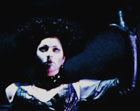 Armida
(American soprano Christine Goerke, photo left) made her entrance singing
her vengeance aria “Furie terribili!” atop a large marble cube,
which later served as a prison for Rinaldo and his beloved Almirena. Goerke
proved an excellent Handel singer, bringing technical ability, power,
and sensitivity to her slow and fast arias. As an actress, Goerke’s
campy humor reminded one of Bette Midler, with a dark touch of Morticia
Addams and Madeleine Kahn. Her spectacularly campy “coups de theatre”
and buffo shtick had the audience in stitches. Armida
(American soprano Christine Goerke, photo left) made her entrance singing
her vengeance aria “Furie terribili!” atop a large marble cube,
which later served as a prison for Rinaldo and his beloved Almirena. Goerke
proved an excellent Handel singer, bringing technical ability, power,
and sensitivity to her slow and fast arias. As an actress, Goerke’s
campy humor reminded one of Bette Midler, with a dark touch of Morticia
Addams and Madeleine Kahn. Her spectacularly campy “coups de theatre”
and buffo shtick had the audience in stitches.
Soprano Lisa Saffer was a bright, sparkling presence as the goody-two
shoes heroine Almirena. Her aria “Lascia ch'io pianga” was lovely.
Her “Augelletti, che cantate”, accompanied by soprano recorded
solo, was also charming. In faster arias, she occasionally seemed somewhat
taxed by the long lines.
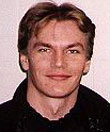 Russian-Israeli
bass Denis Sedov (photo left) as the villain Argente was the revelation
of the evening. He’s a bass-baritone (although sans basso notes)
with a huge, thrilling, masculine sound that filled the hall and sent
chills down one’s back. From his opening aria “Sibillar gli
angui d'Aletto”, the tall, thin 27 year old dominated the production.
His deep, flexible, colorful voice has a molasses-rich, exotic, silky,
growling timbre that reaches across the footlights with extortionate urgency.
His voice is also flexible, as if custom made for singing Handel and Rossini.
His arias excited the loudest applause of the evening, and his curtain
applause was even longer and louder than headliner David Daniels’s.
Critics compared him to Samuel Ramey and the late Norman Treigle. The
good news is that he’ll be singing Escamillo soon, and will surely
develop into a superb Faust, Mephistofeles, and Iago. Russian-Israeli
bass Denis Sedov (photo left) as the villain Argente was the revelation
of the evening. He’s a bass-baritone (although sans basso notes)
with a huge, thrilling, masculine sound that filled the hall and sent
chills down one’s back. From his opening aria “Sibillar gli
angui d'Aletto”, the tall, thin 27 year old dominated the production.
His deep, flexible, colorful voice has a molasses-rich, exotic, silky,
growling timbre that reaches across the footlights with extortionate urgency.
His voice is also flexible, as if custom made for singing Handel and Rossini.
His arias excited the loudest applause of the evening, and his curtain
applause was even longer and louder than headliner David Daniels’s.
Critics compared him to Samuel Ramey and the late Norman Treigle. The
good news is that he’ll be singing Escamillo soon, and will surely
develop into a superb Faust, Mephistofeles, and Iago.
Canadian countertenor Daniel Taylor made his overdue NYCO debut in the
secondary role of Goffredo, the wimpy king. Goffredo was originally sung
in Handel’s 1711 production by a castrato. His arias “No, no,
che quest'alma” and “Sorge nel petto” displayed the pure,
clean line of Taylor’s voice familiar from his early music recordings.
The latter aria got a huge ovation, proving that Taylor’s mellifluous
slow singing can't be beat. His coloratura arias ( “Mio cor, che
mi sai dir?”, etc) were impressively dispatched, with stratospheric
high notes. But one sensed Taylor was happier singing the slower melodic
music. In ornithological terms, he’s more of a dove than a canary.
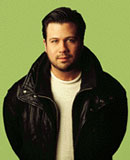 The
justly-celebrated countertenor David Daniels (photo left) was below his
usual excellent level. On opening night he sang feebly, almost as if marking.
From his facial expression it was obvious he was physically struggling
to hit all the notes in his killer part. A few days later (Nov. 9) he
had improved, acting more freely, and throwing in grace notes, but he
was still not as good as he has been in years past. The middle voice was
still sweet and inveigling, and his coloratura was accurate, but the power
wasn’t there. One assumes he was sick. On opening night the rapid
divisions of “Venti, turbini, prestate” were slurred, though
they were better focussed a week later. His famous aria “Cara sposa”
was dragged out until it seemed self-indulgent. “Or la tromba in
suon festante” was stylishly impressive, but one yearned for the
volume, guts and, yes, cojones a female mezzo or alto would bring to this
role. No countertenor can compare with the thrills delivered by a Marilyn
Horne, an Ewa Podles, or a Jennifer Larmore. The
justly-celebrated countertenor David Daniels (photo left) was below his
usual excellent level. On opening night he sang feebly, almost as if marking.
From his facial expression it was obvious he was physically struggling
to hit all the notes in his killer part. A few days later (Nov. 9) he
had improved, acting more freely, and throwing in grace notes, but he
was still not as good as he has been in years past. The middle voice was
still sweet and inveigling, and his coloratura was accurate, but the power
wasn’t there. One assumes he was sick. On opening night the rapid
divisions of “Venti, turbini, prestate” were slurred, though
they were better focussed a week later. His famous aria “Cara sposa”
was dragged out until it seemed self-indulgent. “Or la tromba in
suon festante” was stylishly impressive, but one yearned for the
volume, guts and, yes, cojones a female mezzo or alto would bring to this
role. No countertenor can compare with the thrills delivered by a Marilyn
Horne, an Ewa Podles, or a Jennifer Larmore.
The only serious blemish on this show was the presence of Australian countertenor
Christopher Josey as Eustazio, with an unpleasant nasal timbre and pitch
problems. For some strange reason, Eustazio’s three excruciatingly
long arias (da capos repeats and all) were left intact, while the roles
of Daniels and Taylor were cut. In minor roles, Kevin Burdette was suitably
craggy, hollow-voiced old Magician. The three sirens’ trio “Il
vostro maggio” was deliciously harmonized. The spooky/silly, vaguely
Hindu, blue-faced dancers representing the Furies (choreographed by the
brilliant Ana Yepes) were a wonderful addition. The choreographed battle
scene was also stylish.
The controversial NYCO sound system has been vexing listeners recently,
since no one can trust their own ears. The system’s presence was
not as obvious during Rinaldo as it was during Roberto Devereux earlier
this season, when Lauren Flanagan sounded just as loud singing into the
wings as she did when facing the audience. But I noticed that the orchestra
(parterre) seating (the most expensive in the house) has become acoustically
unreliable. From the supposedly prime location of the 8th row center,
the band sounded muffled and distant, and the singers were strangely feeble.
Other patrons seated in the parterre confirmed this impression. From the
first ring, the sound was fine.
Credits:
Goffredo ............. Daniel Taylor
Rinaldo .............. David Daniels
Almirena ............. Lisa Saffer
Eustazio ............. Christopher Josey
Herald ............... Steven Goldstein
Argante .............. Denis Sedov
Armida ............... Christine Goerke
First Siren .......... Heather Buck
Sirens ................. Jennifer Hines, Kate Aldrich
Christian Magician ... Kevin Burdette
Running time: 3 h. 15 min.
A New York City Opera presentation of the opera in three acts with music by George Frideric Handel and libretto by Giacomo Rossi. Conductor, Harry Bicket. Directed and designed by Francisco Negrin and Anthony Baker. Lighting, Allen Hahn; choreographer, Ana Yepes. Supertitles Cori Ellison.
Copyright by Philip Anson
[INDEX] |
|
|