|
|
|
[INDEX]
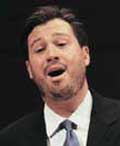 American
countertenor David Daniels headlined two concerts with members of New
York’s Orchestra of St. Lukes at Carnegie Hall this month. Daniels is
one of the world’s top countertenors, so his concerts (rare enough in
New York) command attention. American
countertenor David Daniels headlined two concerts with members of New
York’s Orchestra of St. Lukes at Carnegie Hall this month. Daniels is
one of the world’s top countertenors, so his concerts (rare enough in
New York) command attention.
On Oct. 21, 2004, Daniels sang four Handel arias with the full Orchestra
of St. Lukes led by Sir Roger Norrington, in the huge Isaac Stern auditorium.
Despite the hall’s large size -- some 2600 seats -- Daniels was clearly
heard and managed to project a sense of intimacy. It was good to hear
that his unique instrument remains in fine condition.
His first number, "Va tacito e nascosto" from Handel’s Giulio Cesare,
was slightly tentative as he found his level, but he demonstrated his
trademark flexibility and delicacy in this familiar aria, which he has
sung often and also recorded.
In "Fammi combattere" from Orlando, he omitted the recit, entering directly
into the brief aria, which was so short and sweet it was over before we
had a chance to fully appreciate it..
"Scherza infida" from Ariodante is another Daniels specialty. There was
a moment of uncertainty around the words "per tua colpa" that suggested
perhaps the singer and orchestra were at odds regarding tempo. But the
aria ended with Daniels's trademark honeyed croon, and the audience roared
its appreciation.
The sole encore was "O Lord, Whose Mercies Numberless" from Saul, sung
with breathtakling beauty. Let’s hope Daniels’s next CD features selections
from Handel’s English works.
The purely instrumental part of the concert included Purcell’s Fairy Queen
Suite, eleven snippets that made for a rather bumpy ride, despite Norrington’s
dancing about the stage and even at one point flapping his wings like
a bird.
A few minutes of Incidental Music (Entrée des songes) from Handel’s Alcina
passed pleasantly enough.
After the intermission, Norrington delivered Handel’s Water Music in two
big dollops -- first the suite in F, then the D and G suites mixed together.
Despite his reputation for musicological experimentation, Norrington led
rather tamely. Some of the orchestra members held their bows in baroque
fashion, but the sound was modern, and there was little "original instrument"
flavour to the proceedings.
The evening was long, and several audience members left during the Handel
suites. In terms of programming, less Water Music and more Daniels would
have been welcome.
On Oct. 27, 2004, Daniels sang Scarlatti with the St. Lukes Chamber Ensemble
in Zankel Hall, a subterranean space beneath the Stern auditorium.
The concert opened with Bach’s Concerto for Oboe d`Amore and Orchestra
in A Major, BWV 1055. The middle Larghetto dragged a bit, but the opening
and closing Allegro movements were sparkling, confidently negotiated by
oboist Stephen Taylor, who used sheet music.
Again in Bach’s Concerto for Violin and Orchestra in A Minor, BWV 1041,
the slow movement was less successful than the fast movements, and the
humidity in the hall may have had an adverse effect on the violin of soloist
of Krista Feeney, who played from memory, to her credit.
Daniels sang Scarlatti’s lugubrious motet "Infirmata, vulnerata" accompanied
by bass, violins, cello and harmonium. More interesting was Scarlatti’s
cantata "Perchè tacete, regolati concenti?", full of verbal and vocal
challenges which kept Mr. Daniels glued to his music stand. A highlight
was the slow aria "Dormi, ma sappi almen", which cast an enchanting spell,
with its lullaby pacing and sinuous line, which Daniels couched in vocal
velvet.
A word about Zankel Hall. It is built at subway level, and the N and R
trains roar by every few minutes. Potential ticket buyers should be aware
that the effect is less annoying if you sit on east side of the house
(left as you face the stage).
The Orchestra of St. Luke’s is celebrating its 30th year of existence.
It is an interesting product of the market-driven American classical music
scene. In Europe where public subsidies for the arts are standard, this
band would be housed and supported by a civic or regional political authority.
In the USA, where government support for the arts is nil, a band like
this must follow a commercial model to survive, playing as many gigs as
possible, in whatever musical style is required, from instrumental to
opera, from baroque to modern.
While one may deplore an economic system that forces an orchestra to be
Jack of all trades (living from Handel to mouth, as it were), one must
also note that the St. Luke’s team seems happy, and manages to deliver
a respectable level and variety of music making.
> Carnegie Hall
[INDEX]

|
|
|