|
|
|
[INDEX]
Carnegie Hall: Pittsburgh Symphony Orchestra, Philadelphia Orchestra, Boston Symphony Orchestra
By Philip Anson / December 6, 2004
On the Aisle |  |
Three of the United States’s top orchestras performed in Carnegie Hall
this autumn with results varying from respectable to exceptional.
While the Pittsburgh Symphony Orchestra is not considered one of the “Top
Five” US symphony orchestras (they are Boston, New York, Cleveland, Philadelphia,
and Chicago), it has a distinguished history and is capable of great things.
On Nov. 16, 2004, under the baton of Charles Dutoit, the orchestra offered
a mini-history of ballet music from 1875 to 1911, bridging the gap between
high romanticism and early modernism.
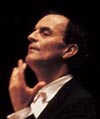 The
concert opened with Act I from Tchaikovsky’s Swan Lake -- not typical
concert fare, and at 50 minutes a longish experiment which occasioned
some grumbling from critics and audience members. The Pittsburgh strings
were good, playing in admirable unison, and delivering tasty tone, especially
in the resinous waltz measures. The winds were also fine, including the
oboe’s crucial contribution to the Russian atmosphere. Alas, the concertmaster
stumbled during the violin solo -- the only “faux pas” in an otherwise
respectable performance. The
concert opened with Act I from Tchaikovsky’s Swan Lake -- not typical
concert fare, and at 50 minutes a longish experiment which occasioned
some grumbling from critics and audience members. The Pittsburgh strings
were good, playing in admirable unison, and delivering tasty tone, especially
in the resinous waltz measures. The winds were also fine, including the
oboe’s crucial contribution to the Russian atmosphere. Alas, the concertmaster
stumbled during the violin solo -- the only “faux pas” in an otherwise
respectable performance.
Dutoit has recorded this work with the Montreal Symphony and from that
gallic band he extracted more silk and refinement. The Pittsburgh ensemble
has an active, forward sound, and their muscular brass would have suited
Prokofiev, or Shostakovich better than Tchaikovsky.
After the intermission we heard Stravinsky’s revolutionary Petrouchka
in the original 1911 version. Again, this is familiar territory for Dutoit.
He led a secure if not electrifying performance, slightly marred by weakness
in trumpet section.
Reviews were mixed. Several critics complained about the choice of flimsy
Swan Lake for a serious concert program. The NY Times missed “lightness
or grace” in the ballet but otherwise praised “robust and brassy” playing.
The hometown Pittsburgh Post-Gazette and Pittsburgh Tribune Review raved.
On the financial front, the Pittsburgh Symphony just announced a $453,000
surplus for its last fiscal year, after a $1.7 million deficit from the
previous year. They also have a new contract, guaranteeing musicians a
base pay in 2005-2006 of $102,403. Nice work if you can get it.
The Philadelphia Orchestra has the most prestigious annual concert series
at Carnegie Hall. On Nov. 23, 2004, under Music Director Christoph Eschenbach,
they performed a bittersweet program combining soothing Austrian schmalz
and alarming German angst.
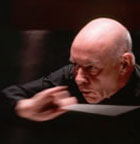 The
program (heard in Philadelphia on Nov. 19, 20, 22) opened with German
composer Matthias Pintscher’s Hérodiade Fragments (1999), a "dramatic
scene" for soprano and orchestra. Pintscher's extended recitation-cum-vocalize
is contemporary, yet firmly in the tradition of Schoenberg’s Pierrot Lunaire
(1912) and Boulez’s Le Marteau sans Maitre (1953-57). The French text,
Hérodiade-fragmente by Stéphane Mallarmé, presents a heroine as crazed
as Strauss’s Elektra and Salome. Pintscher treats the soprano voice as
an instrument like the flute or violin, pushing it to inhuman extremes.
The beautiful American soprano Marisol Montalvo sang, shrieked and crooned
the text through a wide vocal range, with superb discipline and commitment. The
program (heard in Philadelphia on Nov. 19, 20, 22) opened with German
composer Matthias Pintscher’s Hérodiade Fragments (1999), a "dramatic
scene" for soprano and orchestra. Pintscher's extended recitation-cum-vocalize
is contemporary, yet firmly in the tradition of Schoenberg’s Pierrot Lunaire
(1912) and Boulez’s Le Marteau sans Maitre (1953-57). The French text,
Hérodiade-fragmente by Stéphane Mallarmé, presents a heroine as crazed
as Strauss’s Elektra and Salome. Pintscher treats the soprano voice as
an instrument like the flute or violin, pushing it to inhuman extremes.
The beautiful American soprano Marisol Montalvo sang, shrieked and crooned
the text through a wide vocal range, with superb discipline and commitment.
Mahler’s famous Symphony No. 5 needs no introduction. To judge by the
hush that fell over the audience, most came to hear the heart-wrenching
Adagietto, made famous in the soundtrack to Visconti’s Death in Venice.
Unfortunately, this was a drab and decolorized performance. Eschenbach
rushed through the second movement without pace or plan, offering a reading,
not an interpretation. The pastoral third movement was better but the
famous slow movement was sluiggish and ended lamely. It seemed like Eschenbach
had no feel for the tidal ebb and flow of the Mahlerian idiom and the
naïve and piquant folkloric influences (the woodwind invocations of birdsong
and peasant dance tunes went for little). As the New York Times observed,
“Missing … was the wrenching quality - the untempered pathos - that makes
Mahler Mahler.”
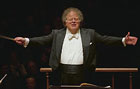
James Levine’s recent appointment as Boston Symphony Orchestra’s Music
Director has caused much rejoicing in Beantown. The BSO’s performance
of Berlioz’s "Roméo et Juliette" (1839) at Carnegie Hall on Dec. 6, 2004,
gave New Yorkers a glimpse of this promising musical marriage.
 It
was an evening of memorable quality. The first movement of Berlioz's “dramatic
symphony” showcased the BSO’s virtuoso brass. Mezzo soloist Lorraine Hunt
Lieberson delivered the gorgeous solo “Premiers transports” in a haunting
tone, but her vibrato widened uncomfortably at the top. The second movement’s
“Mab” solo brought Matthew Polenzani’s high tenor to fore. The “grand
festivity at the Capulets” sounded too much like a German oompah band,
but the technique was solid. The third movement love scene was notable
for superb string playing; the overall effect was lyrical but not ecstatic.
The Queen Mab scherzo offered admirably delicate scampering strings. Levine
offered a strangely leaden and affectless death scene in movement VI . It
was an evening of memorable quality. The first movement of Berlioz's “dramatic
symphony” showcased the BSO’s virtuoso brass. Mezzo soloist Lorraine Hunt
Lieberson delivered the gorgeous solo “Premiers transports” in a haunting
tone, but her vibrato widened uncomfortably at the top. The second movement’s
“Mab” solo brought Matthew Polenzani’s high tenor to fore. The “grand
festivity at the Capulets” sounded too much like a German oompah band,
but the technique was solid. The third movement love scene was notable
for superb string playing; the overall effect was lyrical but not ecstatic.
The Queen Mab scherzo offered admirably delicate scampering strings. Levine
offered a strangely leaden and affectless death scene in movement VI .
In the concluding movements, bass-baritone Julien Robbins sounded old
as Friar Laurence. His French diction and that of the chorus was not always
clear.
This was not a very French interpretation of Berlioz’s work. It mixed
refined execution with inexplicable stodginess. Yet one always felt Levine
was in full control and extracting quality from his musicians. The evening
ended with an impressive choral tutti which left the crowd happy.
> Carnegie Hall
[INDEX]

|
|
|