|
|
|
[INDEX]
CD & DVD Reviews: Tenor Arias (Janos Lotric/Naxos), Brahms: Hungarian Dances (Järvi / LSO/Chandos), Brahms: German Requiem (Karajan/BPO/EMI & Albrecht/Danish NSO/Chandos), Purcell: Dido and Aeneas (Jacobs / Harmonia Mundi), Delibes: Coppelía (Paris Ballet)
By Philip Anson / September 13, 2003
On the Aisle |  |
Tenor Arias
Janos Lotric, tenor
Johannes Wildner / Ukranian National Opera
Symphony Orchestra
Naxos 8.555920 (62.07)
1 star $
 The
music industry’s search for the Next Tenor unearths some rough diamonds
and some negligible rhinestones. Ukranian tenor Janos Lotric is one of
the latter. He has a dull, matte, grainy timbre. His high notes are middle-weight
and tight, but they seem to be his only resource, since his lower voice
often catches in his throat and trembles from lack of support. Nothing
he sings on this disc (taped in 2001) is attractive or competitive with
the better tenors performing today. Even controversial youngish tenors
like Salvatore Licitra and José Cura are much more satisfying. The recording
has some rough, audible splices. The
music industry’s search for the Next Tenor unearths some rough diamonds
and some negligible rhinestones. Ukranian tenor Janos Lotric is one of
the latter. He has a dull, matte, grainy timbre. His high notes are middle-weight
and tight, but they seem to be his only resource, since his lower voice
often catches in his throat and trembles from lack of support. Nothing
he sings on this disc (taped in 2001) is attractive or competitive with
the better tenors performing today. Even controversial youngish tenors
like Salvatore Licitra and José Cura are much more satisfying. The recording
has some rough, audible splices.
Brahms: Complete Hungarian Dances
Neeme Järvi / London Symphony Orchestra
Chandos CHAN X10073
3 stars $$$
 There
are dozens of recordings of Brahms’s Hungarian Dances in the catalogue,
among them several treasurable performances. This 1988 recording, now
remastered in 24-bit digital and released on Chandos’s mid-price Classics
label, has virtues but does not place in the top tranche. The London Symphony
Orchestra is a very fine ensemble. It plays with technical assurance and
panache. The instruments (especially horns and oboes) are spot on. The
sound is sweeping and lush. But the LSO’s Hungarian Dances lack stylistic
authenticity and Middle European flavour. The Estonian maestro and the
British band imbue the dances with Hollywood schmaltz, not with Hungarian
schwung. The grand sonic gestures are inflated and slick, but pack a relatively
small intellectual and emotional punch. What should be hummable, singable
melodies turn into orchestral etudes. This British ham needs more paprika.
All very competent, but not perhaps worthy of repeat listening on CD. There
are dozens of recordings of Brahms’s Hungarian Dances in the catalogue,
among them several treasurable performances. This 1988 recording, now
remastered in 24-bit digital and released on Chandos’s mid-price Classics
label, has virtues but does not place in the top tranche. The London Symphony
Orchestra is a very fine ensemble. It plays with technical assurance and
panache. The instruments (especially horns and oboes) are spot on. The
sound is sweeping and lush. But the LSO’s Hungarian Dances lack stylistic
authenticity and Middle European flavour. The Estonian maestro and the
British band imbue the dances with Hollywood schmaltz, not with Hungarian
schwung. The grand sonic gestures are inflated and slick, but pack a relatively
small intellectual and emotional punch. What should be hummable, singable
melodies turn into orchestral etudes. This British ham needs more paprika.
All very competent, but not perhaps worthy of repeat listening on CD.
Brahms: A German Requiem, Op. 45
Karajan/Berlin Philharmonic
EMI Encore 7243 58505429 (75.20)
Brahms: Ein Deutsches Requiem, Op. 45
Gerd Albrecht/Danish National Symphony Orchestra
Chandos CHAN 10071 (66.32)
These two recordings of Brahms’s German Requiem present diametrically
opposed interpretations. Karajan’s 1972 version (2 stars) is typical bombastic
late Karajan, combining technical proficiency with numbing gigantism.
The massed forces of the Berlin Philharmonic and the Wiener Singverein
deliver an overdetermined, propagandistic reading that defeats the humbling,
sacred purpose of a requiem. The deafening climaxes in “Denn alles Fleisch”
may have been impressive live. On CD, this kind of hectoring is frightening
and fatiguing. Karajan’s hubris now seems outdated. Today we seek more
psychologically subtle, refined, heartfelt interpretations of even the
big set pieces like Brahms’s German Requiem. The original-instrument,
period-performance movement has opened our eyes and ears to the joys of
modest forces carefully deployed. Big is no longer necessarily better.
On the plus side, baritone José van Dam’s “Herr, lehre doch mich” is sensitive
and eloquent. Soprano Anna Tomowa-Sintow is too strident and Senta-ish
in her solo “Ihr habt nun Traurigkeit.” EMI’s recorded sound is very close
to the orchestra and unpolished (there are audible coughs and stage noises).
 Gerd
Albrecht’s recording of the Brahms’s Requiem (3 stars) is intimate, delicately
accented and almost domestic in scale. Though his Danish orchestra and
choir are large and capable of power, they sound chamberish in the best
sense. The performance is always detailed and respectful of the music
and audience, never self centred. Albrecht prefers generally slow tempi,
which permits the instruments to sing individually (harp and oboe are
perfectly clear and balanced). There’s a nice leisurely pulse to “Selig
sind.” The orchestra provides a comfortable pillow of sound for the choir
and soloists. The “Wie lieblich” is delicate and lyrical. Baritone Bo
Skovhus has a plain timbre but his manly, earnest delivery is suitable.
Unfortunately, soprano Inger Dam-Jensen sounds pushed and breathy in “Ihr
habt.” On top of that, there are staticky crackles on the CD during her
aria. This may be a manufacturing flaw, but nevertheless it renders the
CD worthless. Gerd
Albrecht’s recording of the Brahms’s Requiem (3 stars) is intimate, delicately
accented and almost domestic in scale. Though his Danish orchestra and
choir are large and capable of power, they sound chamberish in the best
sense. The performance is always detailed and respectful of the music
and audience, never self centred. Albrecht prefers generally slow tempi,
which permits the instruments to sing individually (harp and oboe are
perfectly clear and balanced). There’s a nice leisurely pulse to “Selig
sind.” The orchestra provides a comfortable pillow of sound for the choir
and soloists. The “Wie lieblich” is delicate and lyrical. Baritone Bo
Skovhus has a plain timbre but his manly, earnest delivery is suitable.
Unfortunately, soprano Inger Dam-Jensen sounds pushed and breathy in “Ihr
habt.” On top of that, there are staticky crackles on the CD during her
aria. This may be a manufacturing flaw, but nevertheless it renders the
CD worthless.
Purcell: Dido and Aeneas
René Jacobs / Orchestra of the Age of Enlightenment
Harmonia Mundi / HMX 2901683 (59.33)
4 stars $$
 This
recording of Purcell’s Dido and Aeneas is re-released in harmonia mundi’s
uniform series of operas conducted by Belgian early music maestro René
Jacobs. It is a very fine recording of a seminal and winning work. The
cast is excellent, with soprano Lynne Dawson as a fine Dido. Her “When
I am laid” is refined and dignified. The Clare College Choir is superb,
captured in a ravishingly resonant acoustic. The countertenor witches
are campy and raucous, but not offensive. Jacobs elicits a respectful
and noble performance from the Orchestra of the Age of Enlightenment.
Recommended. This
recording of Purcell’s Dido and Aeneas is re-released in harmonia mundi’s
uniform series of operas conducted by Belgian early music maestro René
Jacobs. It is a very fine recording of a seminal and winning work. The
cast is excellent, with soprano Lynne Dawson as a fine Dido. Her “When
I am laid” is refined and dignified. The Clare College Choir is superb,
captured in a ravishingly resonant acoustic. The countertenor witches
are campy and raucous, but not offensive. Jacobs elicits a respectful
and noble performance from the Orchestra of the Age of Enlightenment.
Recommended.
Delibes: Coppelía
Coleman / L’Orchestre de l’Opéra Nationale de Paris
TDK DVUS-BLCOP (DVD 119.00)
5 stars $$$
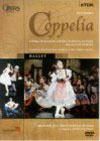 One
can heartily recommend this rewarding DVD of Léo Delibes ballet Coppelía
danced by the teenage students of the Paris Opera Ballet school. The dancers
are young, but there is nothing amateurish about the production, in a
version by Albert Aveline, staged by Pierre Lacotte and school directrix
Claude Bessy. The students, who have been rigorously trained, are superb.
Franz is danced by the willowy Mathieu Gano, Swanilda by the charming
Charline Giezendanner. Best of all is the bonus documentary “Les enfants
de la danse,” a 52 minute condensation of four fine programs originally
broadcast in 1988 on French TV. This behind-the-scenes show reveals the
blood, sweat and tears required to become a top ballet dancer. It also
features interviews with Bessy, Roland Petit, and several adult stars
of French ballet. One
can heartily recommend this rewarding DVD of Léo Delibes ballet Coppelía
danced by the teenage students of the Paris Opera Ballet school. The dancers
are young, but there is nothing amateurish about the production, in a
version by Albert Aveline, staged by Pierre Lacotte and school directrix
Claude Bessy. The students, who have been rigorously trained, are superb.
Franz is danced by the willowy Mathieu Gano, Swanilda by the charming
Charline Giezendanner. Best of all is the bonus documentary “Les enfants
de la danse,” a 52 minute condensation of four fine programs originally
broadcast in 1988 on French TV. This behind-the-scenes show reveals the
blood, sweat and tears required to become a top ballet dancer. It also
features interviews with Bessy, Roland Petit, and several adult stars
of French ballet.
[INDEX]

|
|
|