|
|
|
[INDEX]
Canadian soprano Karina Gauvin made her New York recital debut at Lincoln
Center on April 29, 2002. Gauvin is well-known in Canada, less so in the
USA, which explains the small turnout, about a hundred souls (including
representatives of Quebec Government House) half-filling the 268-seat
Walter Reade Theater. Despite the low turnout, Gauvin gave one of the
best song recitals of the season. Even the Lincoln Center talent scouts
were impressed, almost guaranteeing her a return engagement.
 From
the first notes of Schubert’s Ellens Gesang II, D. 838, Gauvin entranced
the audience with her silvery, natural, feminine timbre, reminiscent of
the great Elly Ameling. New York hears plenty of great opera singers,
but recitalists as good as Gauvin are much rarer. Good recitals are a
question of scale and focus. Most opera singers blast us at recitals with
turbocharged phonation. Gauvin has the gift of intimacy. Her voice is
fresh and delicate, appealing to the ear and senses like the gentler forms
of speech. Thus it is perfect for baroque repertory and song recitals.
When she sings Schubert’s Die junge Nonne, we are convinced she could
be the nun. From
the first notes of Schubert’s Ellens Gesang II, D. 838, Gauvin entranced
the audience with her silvery, natural, feminine timbre, reminiscent of
the great Elly Ameling. New York hears plenty of great opera singers,
but recitalists as good as Gauvin are much rarer. Good recitals are a
question of scale and focus. Most opera singers blast us at recitals with
turbocharged phonation. Gauvin has the gift of intimacy. Her voice is
fresh and delicate, appealing to the ear and senses like the gentler forms
of speech. Thus it is perfect for baroque repertory and song recitals.
When she sings Schubert’s Die junge Nonne, we are convinced she could
be the nun.
Her Mahler songs were less successful, scattered with small errors that
suggests she sings German phonetically, without fully understanding the
language. In “Wer hat dies Liedlein erdacht?” she should have been more
assertive, biting the German words to give them their proper value. Eight
songs by Massenet and Chausson were pleasant. Poulenc’s Fiançailles pour
rire was idiomatic. It was a rare treat to hear French sung properly.
Three folksongs by Britten concluded the nicely balanced and accessible
program, full of intelligent and tuneful works. Gauvin’s accompanist was
Michael McMahon, who contributed poetic accompaniment. Her encores were
“Buddy on the night shift” (?) and a Scottish folksong arranged by Healey
Willan (“Ae fond kiss”?).
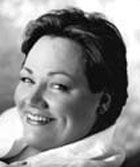
On May 12, American mezzo Stephanie Blythe’s fans almost filled the 1096-seat
Alice Tully Hall. Blythe is one of the hottest young American singers,
with several top awards and regular appearances at the Metropolitan Opera
under her belt. She is a born opera singer, with a huge, rich voice that
is ideal for opera houses. Like the greatest opera singers, she has the
remarkable ability to project and focus her sound over the audience, surrounding
us with a bath of vibrant tone.
 Blythe’s
French diction was very good in six songs by Ernest Chausson. Her lament
on the death of the hummingbird in Le Colibri was moving. But compared
to Gauvin (who also sang Le Colibri, Les papillons, and Le Temps des lilas
in her recital a fortnight earlier), Blythe’s melodies were generalized.
Gauvin pirouetted and pranced, whereas Blythe rode her voice at a gallop
and couldn’t quite float the high pianissimos at the end of Chausson’s
Serenade. Charles Martin Loeffler’s Quatre Poemes for Voice, Viola, and
Piano, Op. 5, were a fin de siecle novelty. The recital ended with Elgar’s
Sea Pictures, Op. 37. The piano version of these lush orchestral songs
is rather thin but Blythe made a good case for Elgar's neglected works.
Her voice was heard at its best belting out forte passages in Sabbath
Morning at Sea, less so when reaching for the soft, high note in Sea Slumber
Song. She gave one encore, an American song. Her deft, sensitive and self-effacing
accompanist was the estimable Warren Jones, who soloed in Griffes’s Barcarolle,
Op. 6, No. 1. Blythe’s
French diction was very good in six songs by Ernest Chausson. Her lament
on the death of the hummingbird in Le Colibri was moving. But compared
to Gauvin (who also sang Le Colibri, Les papillons, and Le Temps des lilas
in her recital a fortnight earlier), Blythe’s melodies were generalized.
Gauvin pirouetted and pranced, whereas Blythe rode her voice at a gallop
and couldn’t quite float the high pianissimos at the end of Chausson’s
Serenade. Charles Martin Loeffler’s Quatre Poemes for Voice, Viola, and
Piano, Op. 5, were a fin de siecle novelty. The recital ended with Elgar’s
Sea Pictures, Op. 37. The piano version of these lush orchestral songs
is rather thin but Blythe made a good case for Elgar's neglected works.
Her voice was heard at its best belting out forte passages in Sabbath
Morning at Sea, less so when reaching for the soft, high note in Sea Slumber
Song. She gave one encore, an American song. Her deft, sensitive and self-effacing
accompanist was the estimable Warren Jones, who soloed in Griffes’s Barcarolle,
Op. 6, No. 1.
If this recital didn’t touch me, it may be because Blythe’s sound is more
instrumental than carnal. It reminds one of a brass instrument or an organ,
lacking the pulpy, feminine warmth that establishes a visceral connection
between singer and listener.
> Lincoln Center
[INDEX]

|
|
|