|
|
|
[INDEX]
New York's classical music scene offers many opportunities to compare
music and musicians under almost scientifically controlled conditions.
During a recent seven-day period at Carnegie Hall one could sample the
artistry of three world-class baritones - Matthias Goerne, Russell Braun
and Thomas Quasthoff. I attended the lieder recitals of the first two,
Goerne and Braun.
 The
German Matthias Goerne is often described as the heir of Dietrich Fisher-Dieskau,
who was one of his teachers, but Fi-Di and Goerne are very different performers.
Goerne's voice is a plummy, cosseting baritone running deep and smooth,
with aeolian stamina and Slavic darkness. Like his Russian peer Dmitri
Hvorostovsky, his strength in recital is atmosphere and tone. Fisher-Dieskau,
on the other hand, was the high priest of lieder as art form. He was an
intelligent interpreter who exhumed and explicated texts and reincarnated
a vanished tradition. Even when his voice wasn't pretty, the songs' meaning
got through. Goerne, on the other hand, has a tendency to put his feet
up and let his lovely voice carry the day. The
German Matthias Goerne is often described as the heir of Dietrich Fisher-Dieskau,
who was one of his teachers, but Fi-Di and Goerne are very different performers.
Goerne's voice is a plummy, cosseting baritone running deep and smooth,
with aeolian stamina and Slavic darkness. Like his Russian peer Dmitri
Hvorostovsky, his strength in recital is atmosphere and tone. Fisher-Dieskau,
on the other hand, was the high priest of lieder as art form. He was an
intelligent interpreter who exhumed and explicated texts and reincarnated
a vanished tradition. Even when his voice wasn't pretty, the songs' meaning
got through. Goerne, on the other hand, has a tendency to put his feet
up and let his lovely voice carry the day.
Goerne's April 19 recital found him slightly below his usual level. He
offered a program of Mahler and Brahms lieder in the vast 2,804-seat Isaac
Stern Auditorium. In principle, lieder recitals should never be given
in such a vast space. But it is understandable that singers with large
followings prefer to accommodate the maximum number of fans even at the
loss of intimacy. The space was fairly full despite the fact that Goerne
had sung similar programs in New York recently. The concert opened with
eight songs from Mahler's Des Knaben Wunderhorn. The works were delivered
competently but without Goerne's usual degree of passion and engagement.
There were several memory lapses (lines skipped, repeated, or in the wrong
order), suggesting that he was tired or distracted. He smoothed over these
glitches with consummate professionalism, but for some of us, Mahler is
a composer who does not survive a second-class performance.
The six Brahms lieder were more successful, though the dirge-like, nocturnal
themes were draggy. In the last three lines of Lerchengesang Op. 70, No.
2, Goerne gave a glimpse of his best tonal magic, but it was a small oasis
of beauty in a long dry program. Brahms's Four Serious Songs followed.
These sublime works can hardly fail, but Goerne's version was less successful
than Thomas Quasthoff's breathtakingly poignant performance at Lincoln
Center last year (click here
for my review).
Goerne's accompanist Eric Schneider was much more present and aggressive
than previously. His playing was smart, quirky, challenging and refreshing.
Goerne has clearly given him carte blanche to be his own man and the result
is much more successful than Goerne's brief partnership with Alfred Brendel
last year.
German-born Canadian baritone Russell Braun made his Carnegie Hall recital
debut on April 26. The 280-seat Weill Hall was almost full and included
many fellow Canadians, singers (including Canadian soprano Isabel Bayrakdarian),
publicists, and agents. It would be nice to report a triumph for the personable
singer, but that wasn't quite the case.
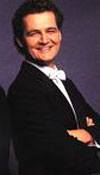 Braun
offered a mixed program of German lieder and English song which he should
have been able to ace. But for some reason, he plodded tensely through
the recital and left this listener disappointed. I am not familiar enough
with Braun's work to judge if he was better or worse than usual. But I
can say that his accompanist (and wife) Carolyn Maule was no help. Braun
offered a mixed program of German lieder and English song which he should
have been able to ace. But for some reason, he plodded tensely through
the recital and left this listener disappointed. I am not familiar enough
with Braun's work to judge if he was better or worse than usual. But I
can say that his accompanist (and wife) Carolyn Maule was no help.
Greater love hath no man than to hire his wife for his Carnegie Hall
debut, when so much is at stake. On this occasion, Maule proved an earnest
but uninspired partner, failing in an accompanist's principle duties:
to support, complement, and enhance the singer. In an angsty song like
Schubert's Uber Wildemann D.884, it didn't matter because Braun was barnstorming.
But elsewhere, instead of supporting the melody and accenting the drama,
she drew attention to herself.
Under such circumstances it is hard to judge Braun. He belongs to the
lucky group of opera singers who can scale their voices down to sing lieder
effectively. He has good diction and a pleasant, smooth, medium-bodied
voice. But during this recital, he seemed to have only three settings:
a neutral middle voice, an ominous whisper and a dramatic bark. Maybe
it got better in the second half. Dispirited by the proceedings, I left
after the first half, with one good memory: a revelatory ballad by Carl
Loewe called Tom der Reimer, Op. 135a.
The moral of this story is to beware husband-wife teams, or any casting
choice that is made for non-artistic reasons. I recall that American baritone
Nathan Gunn was hampered by his wife/accompanist Julie Jordan Gunn at
his 92nd
Street Y recital debut on March 13, 2001. Placido Domingo hires his
talentless wife to direct many operas in which he sings, like the recent
dreadful
Sly at the Met. This kind of nepotism may gave the perpetrators a
cozy feeling and fill their family coffers but it leaves audiences feeling
betrayed.
PROGRAM
Matthias Goerne, Baritone
Isaac Stern Auditorium
Friday, April 19, 2002 at 7:30 PM
Eric Schneider, Piano
MAHLER Songs from Des Knaben Wunderhorn
MAHLER Der Schildwache Nachtlied
MAHLER Zu Strassburg auf der Schanz
MAHLER Ablösung im Sommer
MAHLER Um schlimme Kinder artig zu machen
MAHLER Des Antonius von Padua Fischpredigt
MAHLER Revelge
MAHLER Nicht wiedersehen!
MAHLER Der Tamboursg'sell
BRAHMS "Nicht mehr zu dir zu gehen," Op. 32, No. 2
BRAHMS "Meerfahrt," Op. 96, No. 4
BRAHMS "Mondenschein," Op. 85, No. 2
BRAHMS "Wehe, so willst du mich wieder," Op. 32, No. 5
BRAHMS "Dämmrung senkte sich von oben," Op. 59, No. 1
BRAHMS "Lerchengesang," Op. 70, No. 2
BRAHMS Vier ernste Gesänge, Op. 121
- Denn es gehet dem Menschen wie dem Vieh
- Ich wandte mich und sahe an alle
- O Tod, wie bitter bist du
- Wenn ich mit Menschen- und mit Engelzungen redete
Encores:
BRAHMS Ach, wende diesen Blick
MAHLER Selbstgefühl
MAHLER Ich bin der Welt abhanden gekommen
--------------------------------------------------------------
Russell Braun, Baritone
Carolyn Maule, Piano
Weill Recital Hall
Friday, April 26, 2002 at 8:00 PM
BEETHOVEN An die ferne Geliebte, Op. 98
SCHUBERT "An die Laute," D.905
SCHUBERT "Geheimes," D.719
SCHUBERT "Gesang" (An Sylvia), D.891
SCHUBERT "Erster Verlust," D.226
SCHUBERT "Über Wildemann," D.884
CARL LOEWE "Der Zauberlehrling," Op. 20, No. 2
CARL LOEWE "Die wandelnde Glocke," Op. 20, No. 3
CARL LOEWE "Tom der Reimer," Op. 135a
CARL LOEWE "Erlkönig," Op. 1, No. 3
GERALD FINZI Let us garlands bring, Op. 18
GEORGE BUTTERWORTH Six Songs from A Shropshire Lad
IVOR NOVELLO "We'll gather lilacs" from Perchance to Dream
IVOR NOVELLO "And her mother came too" from A to Z
ERNEST SEITZ "The World is Waiting for the Sunrise"
GEOFFREY O'HARA "Your Eyes Have Told Me What I Did Not Know"
> Carnegie Hall
[INDEX]

|
|
|