|
|
|
[INDEX]
What a difference a year makes. The Vienna Philharmonic Orchestra (VPO)’s
Carnegie Hall concerts under Pierre Boulez in March 2001 left many New
York critics scratching their heads trying to figure out why they sounded
so off. This year the VPO were back under Bernard Haitink with three spectacular
concerts at Carnegie Hall, and they handily regained their title as probably
the world’s best orchestra.
The VPO concerts this year offered a mini-retrospective of Austrian music
from Mozart and Haydn to Bruckner and Berg. The fun started on Friday
March 15 with an afternoon concert that was qualitatively the best of
the three.
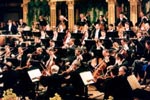 From
the opening bars of Brahms’s Variations on a Theme by Haydn, one marvelled
at the VPO’s refinement and assurance. Most orchestras are happy to hit
most of the right notes, generate some excitement, and be on their way.
The VPO are on another plane altogether. They take note-perfection for
granted. They revel in attaining incredible levels of focus and accuracy
in terms of intonation and dynamic control. The string, brass, and wind
sections are all equally accomplished, resulting in a dreamlike homogeneity
of sound and balance. From
the opening bars of Brahms’s Variations on a Theme by Haydn, one marvelled
at the VPO’s refinement and assurance. Most orchestras are happy to hit
most of the right notes, generate some excitement, and be on their way.
The VPO are on another plane altogether. They take note-perfection for
granted. They revel in attaining incredible levels of focus and accuracy
in terms of intonation and dynamic control. The string, brass, and wind
sections are all equally accomplished, resulting in a dreamlike homogeneity
of sound and balance.
And what accomplishments! The violin section sounds like no other in the
world. The marvel is hard to explain without resorting to metaphysical
imagery (check out their website
for details of their "Klangstil.")
In most orchestras the sound comes directly from the instruments. You
see a bow stroke and you hear a sound. In good orchestras, these sounds
meet somewhere in the auditorium and reach the ear in a more or less blended
form. The VPO’s sound blends closer to its origin in the sections or over
the orchestra and radiates outward like a diffuse light. Instead of hearing
a mix of blended and raw sound, one beholds the completed composition
- balanced, composed and varnished.
Compared to the VPO, most orchestras sound like an old analogue recording,
a product of sweat, breath, wood and metal. The VPO’s sound is digital,
crystalline, and information-packed. Other orchestras produce music in
an industrial fashion, by the piece or by the yard. The VPO's music is
a hand-crafted luxury product. Each player is as invested in the collective
enterprise as if he was the composer. Each performance is as important
to each player as if it was a new commission. So much excellence feels
like more than your senses or intelligence can fully appreciate.
Each of the Brahms’s Variations was a free-standing character study, different
in sense and sensibility from its neighbours, as if played by a completely
different band. The woods and strings displayed a burnished, complex palette
of colors. By some magic, the winds seemed to burble beneath the strings
like a stream flowing below transparent ice. Piccolo and flute runs flashed
like rays of sunshine. Describing the VPO's playing, the inevitable metaphor
is light, not sound.
Haydn’s Clock Symphony (No. 101) was played with chamberish forces (around
50 musicians). The ten or so violins produced a haunting, gossamer sound
that seemed to come from a distance.
After the intermission we were treated to Richard Strauss’s Don Quixote,
Op. 35. It was a genteel performance, not terribly characterful considering
the source material. The viola and cello playing by section players Tobias
Lea and Franz Bartolomey was accurate but not prodigious. Yet it was worth
it for the string playing. The VPO playing Richard Strauss is the very
definition of authenticity. Too bad they didn't play the Rosenkavalier
suite.
On Saturday March 16 the program opened with Mozart’s Symphony No. 35,
rather fast and slick. Alban Berg’s Three Pieces for Orchestra Op. 6 (1914/rev.1929)
were a strange foray into the twentieth-century. The VPO didn’t seem totally
convinced of the importance of this work, and the fault may lie with Haitink,
since last year under Pierre Boulez the VPO played Berg's orchestral pieces
with brilliant simplicity and instinctive virtuosity. The concert ended
with a satisfying traversal of Schubert’s Symphony No. 9 ("The Great").
On Sunday afternoon the VPO offered a luminous performance of Bruckner’s
Symphony No. 8. Too often Bruckner sounds vulgar, tormented, or repetitive.
The VPO showed how it should be played. Bruckner’s introverted labours
in the Scherzo-Allegro-Trio came across as almost Zen-like meditations
on the circularity of time and space. The Adagio seemed like lacrimi cristi,
the expressive struggles of an infinitely isolated soul. Here the violins
and brass limned unexpected subtleties.
Sure, the orchestra was loud, but never has an orchestra played so loud
with such clarity and coherence. The decibels penetrated without pain,
as if searching out the seat of conscience and the foundations of belief.
The two-hour concert passed rapidly and the audience gave the VPO a sincere,
prolonged standing ovation. One Strauss waltz was given as an encore after
the Friday and Saturday concerts. There was no encore after the Sunday
concert.
While all was harmonious musically inside Carnegie Hall, controversy dogged
the VPO in the press and on the sidewalk where a dozen members of the
National Organization for Women (NOW) picketed. NOW’s leaflets claimed
that the VPO had no women members, that its two female candidates on trial
are tokens, and that the women playing on the American tour were substitutes
to pacify liberal US opinion. NOW also pointed out that there are no people
of color in the VPO (the same could be said about most US orchestras).
At Carnegie the VPO had one female violist and one female clarinettist.
Otherwise there were no women. No doubt about it, the VPO is still basically
all-male. Perhaps they are chauvinist fools. Yet to judge by the vociferous
standing ovations by Carnegie Hall’s half-female audience, it would seem
that music lovers of both sexes are sometimes willing to forget their
egalitarian principles in the name of art.
> Carnegie Hall
> Vienna Philharmonic
[INDEX]

|
|
|