|
|
|
[INDEX]
 Decca’s
The Singers is an artist-driven series of compilations touted as “the
most significant and beautiful gathering of great singing on disc.” Each
generously-filled disc contains up to 73 minutes of music, some of it
never before available on CD. Decca’s
The Singers is an artist-driven series of compilations touted as “the
most significant and beautiful gathering of great singing on disc.” Each
generously-filled disc contains up to 73 minutes of music, some of it
never before available on CD.
The main selling-point is the extra “interactive” CD-ROM content accessible
via your Mac or PC computer (the technical requirements are: a CD-ROM
drive, Windows 95 or MAC OS 8.1, 12 MB free HD space and 32 MB free RAM).
This includes liner notes, song texts, a Photo Gallery, and Discography.
Inconveniently, the song texts are not printed in the CD booklet. All
notes and song texts are offered in English, German, and French.
The unsatisfying liner notes by various opera pundtis rarely amount to
more than short hagiographical sketches of each singer larded with “I
heard her when...” reminiscences. Only writer JB Steane refers to specific
recordings and repertoire. There’s no excuse for this when the vast space
on a CD could have held hundreds of pages of biographical and critical
information, opera history, sheet music (such as is offered on Deutsche
Grammophon’s CD Score Plus series), bibliographies, essays on vocal styles,
technical glossaries with sound clips, interviews, etc.
 The
Photo Galleries contain up to two dozen printable photos of the singer,
including all the famous publicity shots of yore. The Discography is unhelpfully
restricted to CDs issued by Universal labels (Decca, Deutsche Grammophon,
Philips). The
Photo Galleries contain up to two dozen printable photos of the singer,
including all the famous publicity shots of yore. The Discography is unhelpfully
restricted to CDs issued by Universal labels (Decca, Deutsche Grammophon,
Philips).
Now to the music. Determined to offer material “never before available
on CD,” the series editors have included some insignificant and unworthy
stuff (see my thumbnail critiques of each disc below). The project suffers
from the exclusion of music from RCA/BMG, EMI, Columbia-Sony, and other
labels. The content is digitally remastered to the new 96kHz 24Bit Super
Digital standard, so the sound is exceptionally clear. This is thrilling
on a good home stereo, but it can mean distortion and splitting if you
listen on lo-fi headphones, Walkman, or computer.
Conclusion: The Singers presents opera in a user-friendly format that
may appeal to computer buffs and would have been good for schools if the
educational content had been greater. But the extra features on the CD
ROM are minimal. Serious and semi-serious opera collectors will already
have the vast majority of this material in a more attractive format (even
old LPs have similar pictures, discography and liner notes). Lets hope
the next 30 issues in this series are more carefully prepared.
> Decca Singers
Brief critiques of each album follow.
Ladies
From best to worst.
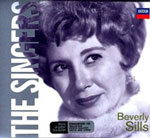
Beverly Sills (Decca 467906). 
American soprano Beverly Sills is at the height of her powers in these
eleven arias and art songs recorded between 1964-1974. Mozart’s Martern
alle arten shows off her exquisite trill. Six arias from French operas
such as Louise and Robert le Diable are warmly sung in an amazingly clear,
precise high soprano.
Teresa Berganza (Decca 467 905).
Six Mozart arias and five Rossini arias recorded in 1959 and 1962 give
a treasurable sampling Berganza’s delicious high, silvery mezzo.
Birgit Nillson (Decca 467912).
Savour the Swedish soprano’s famous Fidelio, Agathe, Isolde, and Sieglinde,
plus a few Italian rarities such as Nabucco and the Forza Leonore.
Jennie Tourel (Decca 467907).
This mixed recital of French mélodies by Ravel and Poulenc and Russian
songs by Tchaikovsky, Balakirev, et al, drips with passion and authenticity.
But Tourel often sounds dry and strained. She was in her 50s when she
made these Decca recordings.
Erna Berger (Decca 467917).
German soubrette soprano Berger is a pert and engaging singer. These archival
recordings from the 1930s, complete with surface noise, are an interesting
snapshot of opera and recital fare in war time Berlin. Everything including
Puccini and Verdi is sung in German. For hard core opera fans only.
Suzanne Danco (Decca 467 909).
Belgian soprano Danco has a firm, accurate, technically secure voice that
lacks personality. These mono recordings from 1948-1953 of eight opera
arias, five Strauss lieder and Debussy’s Ariettes oubliés make a nice
program that fails to catch fire.
Gundula Janowitz (Decca 467 910).
Arias from Freischutz, Oberon, Tannhauser and Lohengrin, lieder by Schubert,
and Strauss’s Four Last Songs conducted by her mentor von Karajan show
the Austrian-German soprano at her best. Yet one may prefer Nilsson and
Flagstad for German opera, and Schwarzkopf, Fleming, or Norman for the
Strauss cycle.
Joan Sutherland (Decca 467 914).
One wonderful Lucia aria from 1959 is this album’s only saving grace.
The awful rest: eight tracks of scoopy Wagner arias and shaky parlor songs
recorded in 1978, and five icky crossover numbers from the 1966 Noel Coward
album. Dame Joan deserves better than this.
Leontyne Price (Decca 467 913).
Six Italian opera arias from Price’s 1980 Mehta/Israel Philharmonic album
find the beloved soprano past herr prime. The addition of seven croaky
carols from Price’s valedictory Christmas album with the Montreal Symphony
Orchestra defies explanation.
Frida Leider (Decca 467 911).
Leider was a great German soprano but these pre-1925 hissy transfers of
Wagner and Weber arias won’t please the average listener.
Renata Tebaldi (Decca 467 915).
Trick or treat from Italian soprano Renata Tebaldi. Treats: Un bel di,
O mio babbino caro, In quel trine morbide; Catalani’s La Wally aria. Tricks:
30 minutes of dreck including post-retirement Baroque stuff sung in a
hard-edged voice.
Male Singers
(from best to worst)
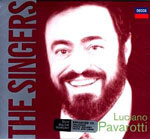
Luciano Pavarotti (Decca 467 920).
Pavarotti’s greatest hits including Nemorino’s aria with nine high C’s,
beautiful selections from Aida and Otello, favourite canzone like Mattinata,
and Nessun dorma, naturally.
Nicolai Ghiaurov (Decca 467 902).
A superb 73-minute album of French and Russian opera arias sung by the
Bulgarian basso cantate. His rich, mellow sound is matched by linguistic
accuracy and dramatic fervor.
Hermann Prey (Decca 467 901).
This compilation showcases German baritone Hermann Prey’s strengths in
opera and lieder, with arias from Rossini’s Il barbiere, Mozart’s Die
Zauberflöte and Nozze, and songs by Schubert, Strauss, Schumann, and Brahms.
Franco Corelli (Decca 467 918).
Corelli’s full-throated, passionate singing is thrilling in arias from
Tosca and Faust, and in duets from Otello (with Zylis-Gara), Gioconda,
Manon Lescaut, and Francesca di Rimini (with Tebaldi).
Marti Talvella (Decca 467 903).
The great Finnish basso applies his warm, expressive voice to Schumann’s
Kerner lieder Op. 35, Mussorgsky’s Songs and Dances of Death, and Rachmaninov
songs. A treat for song recital fans.
Mario del Monaco (Decca 467 919).
Del Monaco’s crisp Italian diction, clear delivery and warm, natural sound
are the gold standard in hit arias from Andrea Chenier, La Bohème, Madama
Butterfly, La Juive, Norma, MacBeth, and Ballo. The Wagner arias, hymns
and crossover tunes are less admirable.
Giuseppe di Stefano (Decca 467 908).
The old magic glimmers through, but even the liner notes admit di Stefano
is past his prime in these 13 opera arias recorded in 1962. Six extra
Sicilian songs add little.
George London (Decca 467 904).
The bass-baritone is stunning in four 1958 arias as the Dutchman, Sachs,
and Wotan. But the rest of the disc is wasted on Broadway tunes by the
likes of Rodgers and Hammerstein, and Lerner and Lowe.
[INDEX]

|
|
|