|
|
|
[INDEX]
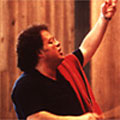 James
Levine (photo left), best known as the artistic director of the Metropolitan
Opera, has done some exciting work with symphony orchestras recently -
notably with the Met Orchestra in its own Carnegie Hall subscription season.
In 2004 Levine will take over the Boston Symphony Orchestra music directorship
from Seiji Ozawa. And since 1999 he has been principal conductor of the
Munich Philharmonic. New York got to hear him conducting three concerts
with his Bavarian band at Carnegie Hall this month and the music world
turned out in force. James
Levine (photo left), best known as the artistic director of the Metropolitan
Opera, has done some exciting work with symphony orchestras recently -
notably with the Met Orchestra in its own Carnegie Hall subscription season.
In 2004 Levine will take over the Boston Symphony Orchestra music directorship
from Seiji Ozawa. And since 1999 he has been principal conductor of the
Munich Philharmonic. New York got to hear him conducting three concerts
with his Bavarian band at Carnegie Hall this month and the music world
turned out in force.
The Feb. 15 concert offered an Austrian program of Mahler and Schubert
which the orchestra had performed a week before in Spain and Italy. It
opened with Mahler’s Symphony No. 4. Historians will note that this symphony
was premiered by the Munich Philharmonic (or its predecessor) under Mahler
himself on Nov. 25, 1901.
In the slow opening movement one immediately noted the orchestra’s distinctive
timbre, a pleasantly antique sound of resinous winds and tarnished bells
that set the Mahlerian mood (a pleasant contrast to the shiny new esthetic
of an orchestra like the Chicago Symphony). Also impressive were the polished
strings, playing at the edge of audibility while conveying the effect
of spectral pastoral melodies heard from afar.
Unfortunately this delicacy was not always evident. The orchestra’s dominant
tendency was to play loud and heartily, with more enthusiasm than wit.
This big, earnest sound is honest music making. It is the correct approach
to dance rhythms such as the Ländler which Mahler evokes in this symphony.
But the muscle wasn’t balanced by melodic gifts or introspective finesse,
no matter how slow Levine conducted. And he conducted very slowly, in
what locals call his "Parsifal mode", stretching every measure
to its limits. Soprano Heidi Grant Murphy sang the "Das himmlische
Leben" conclusion.
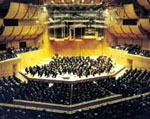 The
Mahler was followed by Schubert’s Symphony No. 9, D. 944. Called "The
Great", it proved at the very least grand, played with muscularity
and grace. Schubert’s classicism seemed to come easier to the orchestra
than Mahler’s neurotic romanticism. The opening Allegro was full-blooded,
with ringing, robust climaxes. The Andante was stately, emphatic and confident.
Levine conjured the right tidal ebb and flow in the final Allegro. The
strings displayed a burnished amber sheen and played ravishing pianissimi.
A few wrong notes and rough edges from the brass and winds were negligible. The
Mahler was followed by Schubert’s Symphony No. 9, D. 944. Called "The
Great", it proved at the very least grand, played with muscularity
and grace. Schubert’s classicism seemed to come easier to the orchestra
than Mahler’s neurotic romanticism. The opening Allegro was full-blooded,
with ringing, robust climaxes. The Andante was stately, emphatic and confident.
Levine conjured the right tidal ebb and flow in the final Allegro. The
strings displayed a burnished amber sheen and played ravishing pianissimi.
A few wrong notes and rough edges from the brass and winds were negligible.
The February 17 program (I did not attend the Feb. 16 concert) opened
with Charles Ives’s Three Places in New England, a period piece with Coplandish
folk coloring and modernistic cacophonic ensembles that veered and slurred
in and out of sync. Beethoven’s Symphony No. 7 followed, a brave traversal
impaired by a frayed, buzzy quality in the horns and trumpets and the
odd violin squeak. Ligeti’s Lontano (1967) proved that the orchestra is
up to the technical demands of monotonous modern music. Brahms’s Symphony
No. 4 closed the long program. It was like the Beethoven, Schubert, and
Mahler heard earlier - competently cooked corned beef where one craved
caviar.
Both concerts were too long and too similar, a test of Sitzfleisch as
much as music appreciation.
The general conclusion seemed to be that the Munich is an earnest young
group who pose no immediate threat to the Berlin Phil, Concertgebouw,
or the Philadelphia Orchestra. The good news is that they are not blasé
like many orchestras. They will grow and improve with time under the right
leadership.
> Carnegie Hall
> Munich Philharmonic
[INDEX]

|
|
|