|
|
|
[INDEX]
The Metropolitan Opera’s "new" production of Verdi’s Luisa Miller looked
so gloomey and drab on opening night that it should have been called Luisa
Mildew.
 Elijah
Moshinsky’s unimaginative conception pointlessly updates the opera's original
feudal Swiss setting ("a small village in a Tyrolese area in the
first half of the 17th century") to Dickensian England, eliminating
the specific historical context which drives the plot. The original tale,
based on Schiller’s play Kabale und Liebe (1784), hinged on the absolute
power of the aristocrats Count Walter and Federica (Duchess of Osterheim)
over their relatives and vassals. The laws of old regime societies made
love and marriage a matter of life and death. But that is hardly true
of Georgian or Victorian England, where people were freer to chose their
wives, husbands, and careers. Fast-forwarding the original Machiavellian
imbroglio to an age of constitutional monarchy simply doesn’t work. Solecisms
abounded. Count Walter belongs in an old castle, not an oak-panelled townhouse.
His references to hunting and honor, as he paces in a frock coat in front
of his cosy fireplace, are jarring. Rodolfo and Wurm verbally threaten
each other with swords that are nowhere to be seen. Elijah
Moshinsky’s unimaginative conception pointlessly updates the opera's original
feudal Swiss setting ("a small village in a Tyrolese area in the
first half of the 17th century") to Dickensian England, eliminating
the specific historical context which drives the plot. The original tale,
based on Schiller’s play Kabale und Liebe (1784), hinged on the absolute
power of the aristocrats Count Walter and Federica (Duchess of Osterheim)
over their relatives and vassals. The laws of old regime societies made
love and marriage a matter of life and death. But that is hardly true
of Georgian or Victorian England, where people were freer to chose their
wives, husbands, and careers. Fast-forwarding the original Machiavellian
imbroglio to an age of constitutional monarchy simply doesn’t work. Solecisms
abounded. Count Walter belongs in an old castle, not an oak-panelled townhouse.
His references to hunting and honor, as he paces in a frock coat in front
of his cosy fireplace, are jarring. Rodolfo and Wurm verbally threaten
each other with swords that are nowhere to be seen.
Broadway designer Santo Loquasto’s undistinguished "realistic" sets of
brick, flaking plaster, and wood looked like the same generic architectural
components every provincial opera house uses to represent European domestic
opera settings. The gloomy lighting and sombre costumes only added to
the depressing effect.
Russian soprano Marina Mescheriakova made her North American debut as
Luisa at the Canadian Opera Company in 1997, a fact the Met Opera doesn’t
mention in its program notes. Back then, the soprano boasted a phenomenally
rich, downy high pianissimo as well as plenty of power. These days she
is husbanding her resources. The high pianissimo is produced less naturally,
and she seems merely to skim the role she formerly bit into. Still, she
acted with guileless gusto and was the show’s main redeeming feature.
Rodolfo was sung by tenor Neil Shicoff, who gave an ardent performance
which made everyone else look wooden. Shicoff’s stony voice is not especially
suited to Italianate roles, but he acquitted himself honorably. One always
feels he is giving his best. The same can’t be said for Russian baritone
Nikolai Putilin who flatly bellowed his way through the role of papa Miller.
His minimal stagecraft included erroneously heading into the wings in
the middle of an aria, then foolishly rushing back to the prompter’s box
for the da capo. Bass Hao Jiang Tian as Count Walter was stolid but reliable.
Putilin and Tian are neither of them actors. Like two leaden bookends,
they anchored an already sluggish show.
Canadian bass Phillip Ens’s Wurm looked like Frankenstein and was well
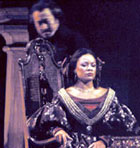
sung without inspiring much fear. American mezzo Denyce Graves (photo
above left) was Federica, Rodolfo’s spurned fiancee. Though she has the
imperious Eboli thing down pat, her voice was brittle around the edges
and broke during a descending line. The excellent young mezzo Maria Zifchak
made a welcome brief appearance as a peasant girl. James Levine’s conducting
was slow but precise.
I can't help contrast the Met's flaccid effort with Christopher Alden’s
thrilling 2000 Spoleto Festival’s Luisa Miller, set in a Tyrolean, feudal,
alpine society which fully dramatized the powerlessness of Luisa, the
religious fanaticism of the peasantry, and the absolute power of the aristocracy.
Alden’s regimented chorus placement emphasized the repression and passive
formality of the mob’s responses. His protagonists, on the other hand,
emoted liberally, cowering, slithering, and dancing like creatures possessed.
Alden’s brilliant production makes the Met’s current half-baked show seem
hopelessly passé.
There were a few dozen empty seats on opening night. One bit of good news:
the Met’s new post-9/11 security means that they now take all bags at
the door, saving one the $2 coat check.
> Metropolitan Opera
[INDEX] |
|
|