|
|
|
[INDEX]
 As
the market for classical music recordings softens and major label recording
contracts vanish, many North American orchestras are starting to commercially
release their own archives. The trend was started two years ago by the
New York Philharmonic and the Chicago Symphony Orchestra. This month the
Boston Symphony Orchestra (BSO) launches its first self-produced public
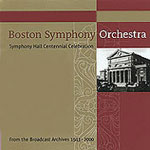
offering: Symphony Hall Centennial Celebration, a 12 CD box of live radio
broadcasts dating from 1943 to 2000. The lavishly packaged set commemorates
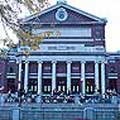
the 100th anniversary of Symphony Hall, the McKim, Mead, and White-designed
building on Boston’s Massachusetts Avenue which has been the BSO’s home
since it was inaugurated on Oct. 15, 1900. As
the market for classical music recordings softens and major label recording
contracts vanish, many North American orchestras are starting to commercially
release their own archives. The trend was started two years ago by the
New York Philharmonic and the Chicago Symphony Orchestra. This month the
Boston Symphony Orchestra (BSO) launches its first self-produced public
offering: Symphony Hall Centennial Celebration, a 12 CD box of live radio
broadcasts dating from 1943 to 2000. The lavishly packaged set commemorates
the 100th anniversary of Symphony Hall, the McKim, Mead, and White-designed
building on Boston’s Massachusetts Avenue which has been the BSO’s home
since it was inaugurated on Oct. 15, 1900.
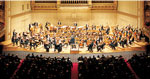
The 15 hours of music in this anthology is chosen to represent the BSO’s
greatest conductors during the 57 years of its recorded history. The 44
works are conducted by the BSO’s six Music Directors: Pierre Monteux,
Serge Koussevitzky, Charles Munch, Erich Leinsdorf and Seiji Ozawa; three
Principal Guest Conductors: Colin Davis, Bernard Haitink, and Michael
Tilson Thomas; nine guest conductors: Thomas Schippers, Igor Markevitch,
Guido Cantelli, Carlo Maria Giulini, Leopold Stokowski, Rafael Kubelik,
Dimitri Mitropoulos, Klaus Tennstedt, and Bruno Walter; two concertmasters:
Richard Burgin and Joseph Silverstein; and Leonard Bernstein and Aaron
Copland. The repertoire is a mixed bag of common and rare, frivolous and
serious. The interpretations range from fascinating to mundane.
 My
favourite selections from this collection include the French disc conducted
by Charles Munch which boasts atmospheric 1958-1962 recordings of Debussy’s
La Mer, Ravel’s La Valse, and Franck’s rarely heard Le Chasseur maudit.
The entire disc conducted by Erich Leinsdorf, including 1964-1967 broadcasts
of Janacek’s Cunning Little Vixen Suite, Shostakovich’s Symphony No. 1,
Wagner’s Siegfried Idyll, and Smetana’s Moldau, is strongly felt and enjoyable.
William Steinberg’s first-class 1972 recording of Bruckner’s Symphony
No. 8 displays the BSO’s plush strings and robust brass. The Principal
Guest Conductors’ disc (recorded 1972-1992) features pleasant interpretations
of common repertoire: Colin Davis’s Vaughan Williams Symphony No. 4, Bernard
Haitink’s Schubert Symphony No. 3, and Michael Tilson Thomas’s Prokofiev
Scythian Suite. My
favourite selections from this collection include the French disc conducted
by Charles Munch which boasts atmospheric 1958-1962 recordings of Debussy’s
La Mer, Ravel’s La Valse, and Franck’s rarely heard Le Chasseur maudit.
The entire disc conducted by Erich Leinsdorf, including 1964-1967 broadcasts
of Janacek’s Cunning Little Vixen Suite, Shostakovich’s Symphony No. 1,
Wagner’s Siegfried Idyll, and Smetana’s Moldau, is strongly felt and enjoyable.
William Steinberg’s first-class 1972 recording of Bruckner’s Symphony
No. 8 displays the BSO’s plush strings and robust brass. The Principal
Guest Conductors’ disc (recorded 1972-1992) features pleasant interpretations
of common repertoire: Colin Davis’s Vaughan Williams Symphony No. 4, Bernard
Haitink’s Schubert Symphony No. 3, and Michael Tilson Thomas’s Prokofiev
Scythian Suite.
Seiji Ozawa’s two discs are also winners, with a richly expressive performance
of Bartok’s Bluebeard’s Castle sung in Hungarian by superb soloists Yvonne
Minton and Gwynne Howell; Richard Strauss’s gorgeous Duet-Concertino with
superb clarinet and bassoon solos; Frank Martin’s rarely heard Concerto
fro seven Wind Instruments, and Messiaen’s Trois Petites Liturgies de
la Présence divine played in the composer’s presence by his wife Yvonne
Loriod (piano) and her sister Jeanne (ondes Martinot). Also recommended
is the guest conductors disc with Stokowski’s peppy Overture to Mozart’s
Don Giovanni and Tchaikovsky’s Hamlet Fantasy Overture; Klaus Tennstedt’s
Brahms Academic Festival Overture, and Rafael Kubelik’s emotional interpretation
of Bohuslav Martinu’s Double Concerto for Two String Orchestras.
 More
problematic are the pre-1960 recordings which display the BSO in its legendary
glory, but which suffer from poor sound quality due to rudimentary miking.
Monteux’s charming 1959 recording of Strauss’s Don Quixote features an
enchanting dialogue in Variation III between cellist Samuel Myers and
violist Joseph de Pasquale, but the strings sound glassy and the trumpets
harsh. Koussevitzky’s zippy Overture to Glinka’s Ruslan and Ludmila is
incredibly exciting despite the spectral and patchy sound. Munch’s great
1953 recording of the Scherzo and March from Prokofiev’s Love for Three
Oranges is impaired by shallow sonics. Comparing these fantastic old recordings
with the BSO’s more recent performances, its hard not to feel that the
orchestra has lost some of its technical prowess, energy, and inspiration. More
problematic are the pre-1960 recordings which display the BSO in its legendary
glory, but which suffer from poor sound quality due to rudimentary miking.
Monteux’s charming 1959 recording of Strauss’s Don Quixote features an
enchanting dialogue in Variation III between cellist Samuel Myers and
violist Joseph de Pasquale, but the strings sound glassy and the trumpets
harsh. Koussevitzky’s zippy Overture to Glinka’s Ruslan and Ludmila is
incredibly exciting despite the spectral and patchy sound. Munch’s great
1953 recording of the Scherzo and March from Prokofiev’s Love for Three
Oranges is impaired by shallow sonics. Comparing these fantastic old recordings
with the BSO’s more recent performances, its hard not to feel that the
orchestra has lost some of its technical prowess, energy, and inspiration.
This box set is handsomely bound in gold and burgundy. The lavish booklets
detail the entire history of the Boston Symphony Orchestra, Symphony Hall,
its conductors, and musicians. At US $225 this set a deluxe offering that
will appeal mainly to libraries and serious collectors. Self-produced
recordings like these are a good way for orchestras like the BSO to cultivate
new audiences and share their artistic legacy. If they want to reach a
wider audience they should release these discs individually, cheaper,
and include some concerto repertoire starring famous pianists, violinists,
and singers.
Symphony Hall Centennial Celebration is sold at Symphony Hall (tel. 888
266-1200), at the Tanglewood Festival, at Virgin Megastores, and through
the BSO website.
> Boston Symphony Orchestra
[INDEX] |
|
|