|
|
|
[INDEX]
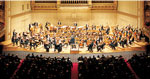 The
BSO opened its annual Carnegie Hall subscription season with Berlioz’s
Requiem, in memory of the victims of the 9/11 terrorist attacks, or "ONT"
- Our National Tragedy - as it is now glibly referred to. The BSO dedicated
their performances this week to Ted Hennessey, the husband of one of their
members, Melanie Salisbury. Hennessey was a passenger on American Airlines
Flight 11. The
BSO opened its annual Carnegie Hall subscription season with Berlioz’s
Requiem, in memory of the victims of the 9/11 terrorist attacks, or "ONT"
- Our National Tragedy - as it is now glibly referred to. The BSO dedicated
their performances this week to Ted Hennessey, the husband of one of their
members, Melanie Salisbury. Hennessey was a passenger on American Airlines
Flight 11.
The BSO had originally scheduled Schumann's "Scenes from Goethe's Faust"
for its Oct. 11, 12, and 13 performances in Boston as well as the two
gigs at Carnegie Hall. But after ONT it opted for the Berlioz Requiem.
The BSO's Managing Director Mark Volpe explained: ''The Faust story starts
with making a deal with the devil. The whole first part is about burning
in hell. And though it ends with redemption, [Music Director Seiji Ozawa]
had a real tough time with the idea of presenting that in New York now.''
The switch from Schumann to Berlioz deprived us of a rare chance to hear
an unusual work. Yet perhaps the Faustian parable of selling ones soul
for youth, wealth, and beauty is too close to the bone for a country paralyzed
by a combustible mix of unfocused anger and righteous denial. Much easier
to pull out the hankies and do the Mass for the Dead thing, rather than
face the hard social, economic, and philosophical repercussions of ONT.
The Berlioz’s Requiem is a favorite work of conductor Seiji Ozawa, who
this season is concluding his 29-year tenure as music director of the
BSO. The work has been in the BSO repertoire for decades. They recorded
it in 1959 (Munch/Leopold Simoneau/RCA Victor) and 1993 (Ozawa/Vinson
Cole/RCA). Despite this familiarity, the performance heard on Oct. 17
was not what it might have been.
 The
Berlioz Requiem is what publicists call a "sonic show-stopper", with four
small brass bands (trombones, tuba) placed at the four corners of the
hall in the balconies. Ozawa even put tenor soloist Stanford Olsen up
there too, a "celestial voice" that was faint on opening night (Oct. 16)
but more effective the next evening. Berlioz’s quirky score played by
the BSO’s very fine musicians was professional and free of blunders, but
it was not personal, cathartic, or brilliant. The
Berlioz Requiem is what publicists call a "sonic show-stopper", with four
small brass bands (trombones, tuba) placed at the four corners of the
hall in the balconies. Ozawa even put tenor soloist Stanford Olsen up
there too, a "celestial voice" that was faint on opening night (Oct. 16)
but more effective the next evening. Berlioz’s quirky score played by
the BSO’s very fine musicians was professional and free of blunders, but
it was not personal, cathartic, or brilliant.
During the Tuba Mirum and Lacrymosa the bands produce a thrilling quadraphonic
effect. Carnegie Hall’s wooden floor vibrated like a huge sounding board.
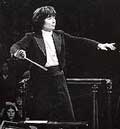
But aside from those passages, the interpretation was routine. Ozawa’s
exaggerated gestures did not produce corresponding musical or emotional
results. He was fully occupied doing 180 degree turns in order to cue
the orchestra, chorus, far flung brass bands, and tenor soloist.
Dynamics were left up to players, hence an intrusive piccolo went unchecked.
Ozawa seemed to think that if he minded the details, the larger picture
would coalesce. But to move an audience, one must have an understanding
of musical psychology. Simply unspooling the score is not enough. One
must be a sorcerer playing on the audiences’ nerves, imagination, expectations,
hopes, and fears.
To impose the solemnity he couldn’t elicit, Ozawa froze in place for 20
seconds after beating the final measure. Yes, we sat in silent embarassment,
but this was no substitute for an emotional performance.
The Tanglewood Festival Chorus prepared by John Oliver is a good group
with fine tenors and sopranos. They have diction and purity of sound,
but they seemed to be as uninvolved as the orchestra. Boston critics noted
the difference between the Boston and New York acoustics. The Boston Herald’s
T. J. Medreck wrote of the Oct. 16 Carnegie performance, "Solo instruments
stood out more clearly, as did the chorus' projection of the Latin text.
But the orchestral and vocal blend was far less warm than we heard back
home last week. So some beauty was lost. But Carnegie's built in extra
oomph heightened the music's dramatic effect."
The Financial Times noted, "The reading tended toward the raucous, probably
more so than the composer intended, and certain acoustical inequities
proved unavoidable. Still, one had to admire the basic grandeur of the
enterprise." That wasn’t enough for Newsday critic Justin Davidson who
found the playing "full of dusty drama and watery effects." He groaned:
"After nearly 30 years, the BSO is Ozawa's orchestra, and he leaves it
sounding bland and vague."
The BSO’s gift to New York was full of good intentions. Yet one expected
more from this piece played by this band on this occasion. Oh well, its
the thought that counts.
> Boston Symphony Orchestra
> Carnegie Hall
[INDEX] |
|
|