 |
 |
|
|
The Lincoln Center Festival's most earnest musical theater offering this summer is 55 year old Italian composer Salvatore Sciarrino's 75 minute chamber opera Luci mie Traditrici (translated as " "My Treacherous Eyes"), a lean, minimal work from 1996 that is ethereal, intense, monotonous, and fascinating. Sciarrino's trademark is his subdued instrumentation. He has said, "The traditional orchestra in opera is dead. The function of the orchestra is no longer to accompany the voices. The voice is everything. It is the center. It is the world of opera. The orchestra creates around the voices only the sounds that the characters can hear." Thus the composer limits himself to a 22-member orchestra of violin, viola, cello, bass, flute, clarinet, bassoon, trumpet, trombone, sax, and percussion. Most of these instruments never make their traditional sounds. Instead, they are blown, tapped, and rubbed in a variety of unconventional ways to elicit a palette of subtle whispers, squeaks, hisses, sighs, and clicks. The brass players exhale through their instruments, producing the sound of wind. The violinists press one string until it produces a high electronic squeak. All these sounds are applied sparingly and in counterpoint to the sung/spoken dialogue, to provide an allusive atmospheric accompaniment. The most traditional music comes in three intermezzos based on baroque music by Claude Le Jeune. As in Britten's Peter Grimes, these intermezzos are among the most accessible part of the opera. The two-act, eight-scene libretto is based on Giacinto Andrea Cicognini's 1664 play "Il Tradimento per l'Onore", based on the life of composer Carlo Gesualdo, Prince of Venosa. The play tells of a jealous Duke (sung by Austrian baritone Paul Armin Edelmann ) who kills his wife (sung by German soprano Annette Stricker) and her lover (the Guest, sung by British countertenor Lawrence Zazzo) after they are betrayed by a Servant (John Bowen). This skeletal libretto with no subplots, poetry, or digression is well-suited to Sciarrino's bony music. The classical Italian is sung/spoken in short , arhythmic syllabic bursts with sliding pitch and volume. The four singers were perfectly comfortable and adept with this difficult technique. Production values were high. The single fixed set by Roland Aeschlimann was a white hill cut by five jagged saw blades moving up and down at irregular intervals. The small stage was surrounded by a semicircular scrim that served to isolate the action from the audience. Blackouts (or rather greyouts) divided the scenes. The orchestra was tucked under one side of the stage, which made it awkward for the conductor to cue the singers, but the ensemble was flawless. As usual with the best European productions, one was impressed by the superb craftmanship reflected in materials scrupulously cut, painted, and fitted with such precision and elegance that it made the average Metropolitan Opera production look dumpy (to say nothing of the shlock frequently foisted upon Opéra de Montreal audiences). Costumes were chic boutique fashions that any socialite would love to wear. Direction by choreographer Trisha Brown was suprisingly muted, almost incidental: a few robotic postures and Robert Wilsonesque hand gestures that suited Sciarrino's esthetic. There was little of the poetic imagination seen in her choreography of Monteverdi's "Orfeo," which wowed us at the Brooklyn Academy of Music a couple of years ago. This co-production with Brussels's Théâtre de la Monnaie and France's Opéra de Rouen was a bold and challenging offering which lasted just long enough to make its point. By the end of the show, one's appetite for Sciarrino was satisfied. The experiment was interesting, but one would not want to hear it again too soon. The Lincoln Center Festival continues through July 29. > Lincoln Center Festival 2001.
|
a |
|
|

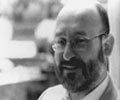 Salvatore Sciarrino: Luci mie Traditrici