|
|
|
[INDEX]
The smell of fresh paint was still perceptible
as champagne corks popped to celebrate reopening of the Cleveland Orchestra’s
sparklingly renovated Severance Hall on the weekend.
Politicians, wealthy patrons, and a bevy of journalists gathered under
the foyer’s glowing gilt plasterwork and brightly restored Egyptian
Revival frescoes to celebrate the conclusion of an ambitious two-year,
$36 million (all amounts in U.S. dollars) facelift that enlarged and improved
almost every part of the stately Georgian-style limestone edifice.
Since the day in 1931 when Severance Hall, designed by the local architectural
firm Walker and Weeks, opened in Cleveland’s posh museum district,
it has been acknowledged as one of America’s great concert venues,
as acoustically and architecturally distinguished as New York’s Carnegie
Hall and Boston’s Symphony Hall.
Oil magnate John Long Severance and local supporters poured $7 million
into the building at the height of the Depression, a testimony to their
civic pride and high esteem for music. Severance Hall was the Cleveland
Orchestra’s first permanent home since it’s founding in 1918,
and they’ve played there on a weekly basis ever since.
 Like
a shabby-genteel governess, Severance Hall served Cleveland well for nigh
on seventy years, becoming a beloved landmark and a focus of the artistic
community, but it suffered from serious practical defects, as well as
the inevitable wear and tear of constant use. Two years ago this month
the orchestra’s Board of Trustees approved a comprehensive renovation
plan, to be overseen by Washington, D.C., based David Schwartz /Architectural
Services. A team of acousticians, restorers, and architects immediately
set to work and the project came in on budget and on time for Saturday’s
opening. As is usual with restorations, it wouldn’t have cost much
more to build a whole new facility from scratch. But sentimental Cleveland
never considered abandoning their eclectic and cosy old concert hall. Like
a shabby-genteel governess, Severance Hall served Cleveland well for nigh
on seventy years, becoming a beloved landmark and a focus of the artistic
community, but it suffered from serious practical defects, as well as
the inevitable wear and tear of constant use. Two years ago this month
the orchestra’s Board of Trustees approved a comprehensive renovation
plan, to be overseen by Washington, D.C., based David Schwartz /Architectural
Services. A team of acousticians, restorers, and architects immediately
set to work and the project came in on budget and on time for Saturday’s
opening. As is usual with restorations, it wouldn’t have cost much
more to build a whole new facility from scratch. But sentimental Cleveland
never considered abandoning their eclectic and cosy old concert hall.
The new user-friendly Severance Hall’s major practical improvement
is a five-story, 39,000 square foot annex seamlessly fused to the back
of the old building, housing administrative offices and backstage areas
for musicians. Female musicians, who were not part of the Cleveland Orchestra
back in 1931, now have washroom facilities of their own. Concert goers
will find enlarged parking facilities and access points, as well as new
conveniently located coatrooms, washrooms, a new restaurant and gift shop.
Getting to and from one’s seat is much easier since corridors have
been widened and pinchpoints eliminated.
Of course, music lovers are most concerned with the effect, if any, of
renovation on the main 2000-seat Concert Hall’s fabled acoustics.
The Cleveland Orchestra has long been considered one of America’s
top five symphony orchestras, and the famous “Cleveland sound”
evolved in Severance Hall under such distinguished music directors Artur
Rodzinski, Erich Leinsdorf, Pierre Boulez, Lorin Maazel, and especially
the feisty Hungarian maestro George Szell.
Szell propelled the orchestra to international fame during his 24 year
tenure which ended in 1970. Recent remasterings on the Sony Masterworks
label of his Cleveland recordings bear witness to the way the orchestra
fitted Severance Hall like a snail fits its shell. Acoustician Christopher
Jaffe was keen to preserve what he calls the hall’s “musical
memory” - in other words, the unique way the orchestra has sounded
in this hall to Cleveland audiences over the decades. He set out to enhance,
not revolutionize, the sound.
At the same time, Jaffe knew that the hall was less than perfect by international
standards. It was rather dry and it needed more liveness. Though fine
for baroque and classical repertoire, the hall lacked the ideal aura for
later Romantic music. He aimed to get a more rounded sound by boosting
microdiffusion of wider frequencies, and to extend the general diffusion
(or reverberation) time from about 1.6 to 1.8 seconds.
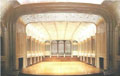
To this end the so-called “Szell shell”, a plain maple wood
hemisphere installed by the Hungarian maestro in 1958, was completely
removed and replaced by a new modular concert shell using state of the
art acoustical design. The new shell springs up from the stage like a
fountain of blond wood and silvery Art Deco foliage, incorporating the
main hall’s vine and pampas grass motifs while serving as a sophisticated
acoustic reflector.
The back of the shell is dominated by three banks of silvery organ pipes
(Severance Hall’s original 6,025 pipe Skinner organ, walled up in
the fifties, will eventually be reinstalled at stage level). Jaffe turned
the empty space left by the organ behind the shell walls into a series
of adjustable acoustic resonating chambers, a simplified version of the
technology made famous by Artek Consultants’ design for the Konzerthaus
in Lucerne, Switzerland. The wavy roof of the new shell plunges forward
in five large macrodiffusive pillows, each covered in wheat-like detailing
to improve microdiffusion. The shell’s background color is pale pinkish
ochre.
Blending the new shell’s look with the old hall’s magnificent
Deco interior turned out to be easier than expected, since the old proscenium
was uncovered virtually intact during renovations. The new shell seems
to flow seamlessly into the main hall, without a visual hitch. The main
hall’s sensuously-curved, stepped-back ceiling glows with an acre
of painstakingly hand-applied peach-tinted pastiglia and glowing aluminum
leaf. The swirling, lacey Art Deco vegetation was copied from the wedding
dress of Mrs. Severance, who died before the building was finished, and
stands as a memorial to her grieving husband’s love. Visually, historically,
and romantically, the Severance concert hall restoration is ravishing.
So how does it sound? Critics got three chances to hear the main concert
hall in action. During a rehearsal without audience the full orchestral
sound carried well and was homogenous throughout the hall. During a chamber
music recital, a trio failed to generate much of an aura. But five Cleveland
Orchestra first desk players made a fine impression playing Brahms’
Quintet for Clarinet and Strings in B minor, Op. 115. It was probably
the best performance heard all weekend. The opening gala concert was a
perplexing and rather unsatisfactory experience. First disappointent:
there were no superstar soloists. Though it is understandable that the
orchestra was celebrating itself, a televised gala is showbiz and calls
for a big name.
Harrison Birtwhistle’s specially commissioned 2 minute Sonance Severance
2000 was a noisy scrum of brass and cymbal clashes. Surely a local American
composer could produced something as good or better. Ligeti’s painfully
shrill Atmospheres was fascinating but not exactly what the $1000 per-plate
gala audience expected. Vaughan Williams’ hackneyed The Lark Ascending
got a mediocre run through by concertmaster William Preucil. Prokofiev’s
Classical Symphony sounded smeary and sluggish. I’ve heard the Montreal
Symphony play it twice as well. Only Ravel’s Suite No. 2 from Daphnis
and Chloe sounded full, balanced and polished. It was hard to tell if
the Cleveland Orchestra or the new hall was at fault, but, in general,
all music below mezzo-forte sounded anemic and trapped onstage behind
the proscenium. Louder than mezzo-forte, the sound spilled into the auditorium
and was incredibly loud (people covered their ears during the Ligeti).
Since this was only the second time the orchestra played with a hall full
of people, they clearly have many months of fiddling with the acoustics
before they settle on ideal new balances, settings, seatings, dynamics
and tempos.
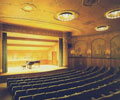 Downstairs
in the 400-seat Reinberger Chamber Hall, which had also been restored
and the stage slightly expanded, the news was all-good. The circular room
is more like an aristocratic salon than a concert hall, with charming
pastoral wall paintings and wood panelling. Norwegian pianist Leif Ove
Andsnes gave a solo piano recital that demonstrated the hall’s charming
warmth and clarity. Along with the Frick Collection in New York, it is
one of the most charming chamber music venues in North America. Downstairs
in the 400-seat Reinberger Chamber Hall, which had also been restored
and the stage slightly expanded, the news was all-good. The circular room
is more like an aristocratic salon than a concert hall, with charming
pastoral wall paintings and wood panelling. Norwegian pianist Leif Ove
Andsnes gave a solo piano recital that demonstrated the hall’s charming
warmth and clarity. Along with the Frick Collection in New York, it is
one of the most charming chamber music venues in North America.
Cleveland promotes itself nationally and internationally as Culture City
and it is putting its money where its mouth is. The renovation of Severance
Hall is just one part of the city’s civic masterplan - which includes
an expanded Museum of Art and the Playhouse Complex - an enviable example
of what can be achieved with a little public pride and a lot of private
money.
It is a bittersweet experience to compare the Cleveland Orchestra’s
wealth with the poverty of Canadian orchestras. Severance Hall’s
$36 million renovation cost (equivalent to the Montreal Symphony’s
total budget for four years) was raised without apparent effort, and the
orchestra’s Twenty First Century Fund has banked another $60 million
in the last two years. In disgraceful contrast, the Montreal Symphony
Orchestra (MSO) and Toronto Symphony Orchestra (TSO) rent space in buildings
with lousy acoustics that were never designed for symphony orchestras.
The TSO’s endowment stands at $13 million (Can.), the MSO at a paltry
$1.5 million. Their annual budgets, around $12 million each, are rarely
balanced. Year after year the MSO needs multi-million dollar emergency
bailouts from the Quebec government to meet payroll. Even though the Montreal
Symphony is arguably a finer ensemble than the Cleveland Symphony, a Cleveland
musician’s base salary is around $100,000 (U.S.), while MSO and TSO
players start at $60,000 (Can.). Given this disparity, it is only a matter
of time before Canadian orchestras devolve into third rate farm teams
for first rate American orchestras.
For more information on the Cleveland Orchestra and Severance Hall restoration,
go to their website: www.clevelandorchestra.com. 2000
> New York City Opera
[INDEX] |
|
|