|
|
|
[INDEX]
 For
all the talk about the "magic of opera", really successful performances
are so rare that dedicated operaphiles have grown accustomed to waiting
long - and travelling far - in search of a sublime theatrical experience.
Productions and performances that succeed in creating the illusion of
a believable parallel world (even for a few minutes, let alone a whole
evening) are the exception to the rule. For every minute of Art, we endure
countless hours of pretentious, banal, incompetent singing and acting.
But when that transcendental moment occurs, the floodgates of feeling
open. One’s patience is rewarded and life suddenly seems worth living. For
all the talk about the "magic of opera", really successful performances
are so rare that dedicated operaphiles have grown accustomed to waiting
long - and travelling far - in search of a sublime theatrical experience.
Productions and performances that succeed in creating the illusion of
a believable parallel world (even for a few minutes, let alone a whole
evening) are the exception to the rule. For every minute of Art, we endure
countless hours of pretentious, banal, incompetent singing and acting.
But when that transcendental moment occurs, the floodgates of feeling
open. One’s patience is rewarded and life suddenly seems worth living.
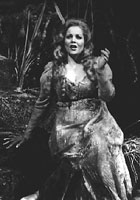
Renée Fleming’s performance in the title role of Dvorak’s Rusalka at the
Metropolitan Opera on May 10, 1997 was one of those life-affirming artistic
experiences.
Rusalka is a water-nymph who trades her immortality for the love of a
human prince. Rusalka is difficult role to cast because few of the vocally
qualified lyric sopranos possess the physical grace and delicacy for the
part. Fortunately Renée Fleming not only has the voice but is blond, svelte,
and feminine. She is also a completely convincing natural actress. Rusalka’s
movements once she leaves her water-world are limited to a sort of swimming
through the air. Costumed in a gauzy iridescent blue gown, Fleming’s slow,
amphibious movements perfectly conveyed Rusalka’s mute struggle in a strange
element. The climax of Fleming’s Kabuki-like gestural theatre occurred
in the last moments of Act III when Rusalka rises from the pond to meet
her prince and watch him die. Fleming seemed to walk on water and float
through the air on this, her final, saddest errand.
Of course the highlight of the opera was Rusalka’s "Song to the Moon."
I have never seen a Metropolitan Opera audience (especially a matinee
audience) so spellbound. The initial respectful silence was soon broken
by sobs of uncontrolled emotion. Many of us were crying -- though we fought
it because we didn’t want to miss a note of Fleming's gorgeous lyricism.
Yet resistance was impossible. Fleming's art made Rusalka’s plaint totally
personal for eaach and every listener. Father, brother, lover, son - clearly
everyone in the audience remembered a prince loved or a prince lost.
Fleming’s Rusalka is obviously the product of consummate artistry and
hard work. Though this is her first Met Rusalka, she has sung the role
in Seattle (1990), Houston (1991), San Diego, and San Francisco (1995).
In addition to her personal beauty and fine acting, Fleming possesses
one of the most beautiful soprano voices I have heard in the last decade.
The sound is womanly, with an ingratiating timbre, pure yet personal,
technically capable of the subtlest nuances with a reserve of great power.
The rest of Dvorak’s opera after the "Moon Song" is charming but a bit
anticlimactic. Fleming continued superb. Sergei Koptchak, a great Russian
bass with remarkable pianissimo, was dramatically and vocally haunting
as the Water Gnome. Mezzo Dolores Zajick’s Jezibaba was comical and intellectually
frightening by turns. Canadian soprano Frances Ginzer was good in the
small role of the Foreign Princess. Only tenor Chris Merritt fell short
of the mark, forcing unpleasantly in order to project and to hit high
notes.
Conductor John Fiore coaxed a delicious performance out of the orchestra,
who were remarkably fresh considering they’d played Wagner all week.
The production, acquired from the Vienna State Opera and first seen at
the Met on November 11, 1993, featured naturalistic sets by Günther Schneider-Siemssen,
who also designed the Met's similarly realistic Ring Cycle. The prince’s
castle was charming. Unfortunately the pond inhabited by the Gnome and
nymphs was obviously just glittery fabric stretched across a hole in the
stage, and the tree Rusalka inhabits beside the pond should be reinforced
and oiled - it creaked audibly throughout the opera.
> Metropolitan Opera
[INDEX] |
|
|