|
|
|
[INDEX]
How do you solve a problem like Medea? That’s the question posed by Deborah
Warner’s earnest but uneven production of Euripides’ play, created for
Dublin’s Abbey Theatre in 2000 and currently on view at the Brooklyn Academy
of Music’s Next Wave Festival.
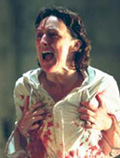 The
problem is twofold, with the eponymous heroine, incarnated here by the
accomplished Irish-born actress Fiona Shaw (photo left), and with the
ancient Greek play itself, awkwardly transposed to modern times in a way
that failed to capture the chilling mythic tragedy of the original. The
problem is twofold, with the eponymous heroine, incarnated here by the
accomplished Irish-born actress Fiona Shaw (photo left), and with the
ancient Greek play itself, awkwardly transposed to modern times in a way
that failed to capture the chilling mythic tragedy of the original.
This modern-dress production drops Medea and Jason into an apparently
contemporary suburban milieu. The set looks like a back yard or a playground
with piles of building material, scattered children’s toys and a wading
pool where Medea’s two doomed boys sail little boats.
Dressed in a cardigan, skirt, and runners, Shaw’s Medea is no longer the
terrifying Greek witch of legend. On the contrary, she comes across as
a frustrated housewife who left her homeland Colchis to follow Jason to
Greece, where he jilts her and the local King banishes her. To get even
with Jason, she kills their kids.
Those are the facts of a play which Warner’s production fails to make
believable or, despite updating, relevant.
One problem is that the 2400-year old text (translated by Kenneth McLeish
and Frederic Raphael) is served up to a contemporary audience for unmediated
and uncontextualised consumption. The result is an uneasy mix of archaic
declamation and laughter-inducing non-sequiturs. The tragicomic blend
is confusingly Shakespearean, but whereas Shakespeare is our contemporary,
Euripides is not.
Warner has not addressed this simple but fundamental historical disjunct.
The original Attic tragedy hinged on the motivations, values and assumptions
of the ancient Greeks while conforming to their strict dramatic codes.
Greeks were concerned with issues such as fate, dynasties, filial piety,
treachery, divine intervention, the god-mortal relationship, the status
of demigods, good death, proper funeral rites, religious rituals, and
so on. Warner doesn’t translate them into modern terms. She simply glosses
over them, offering no substitutes or equivalents. Without the ancient
Greek value system to spiritualise the drama, the action seems no more
important than an episode of tabloid squalor.
 To
compensate for its weak intellectual superstructure, this production attempts
to generate emotional impact through sound and fury. The acting is intense,
the movement kinetic, the decibel level high. Everyone screams, wrestles,
and runs in circles. As one British critic wrote, every line was delivered
as if it was the play's climax. There were some nice, subtle, effectively
understated touches, such as a radio playing faintly as the murders happen
offstage. Unfortunately these moments of calm introspection were outnumbered
by heavy-handed or irrelevant add-ons, such as silly business with toys
(including a burning teddy bear), endless dashing up and down the theatre’s
aisles, and deafening cacophony over the loudspeakers. This overwrought
delivery paradoxically undermined the play's psychological impact. Famed
director Peter Hall once noted that Greek tragedy needs the ancient tradition
of masks to control and channel the harrowing emotion. Instead of masking/enhancing
the obvious, Warner lets it all hang out, with numbing results. To
compensate for its weak intellectual superstructure, this production attempts
to generate emotional impact through sound and fury. The acting is intense,
the movement kinetic, the decibel level high. Everyone screams, wrestles,
and runs in circles. As one British critic wrote, every line was delivered
as if it was the play's climax. There were some nice, subtle, effectively
understated touches, such as a radio playing faintly as the murders happen
offstage. Unfortunately these moments of calm introspection were outnumbered
by heavy-handed or irrelevant add-ons, such as silly business with toys
(including a burning teddy bear), endless dashing up and down the theatre’s
aisles, and deafening cacophony over the loudspeakers. This overwrought
delivery paradoxically undermined the play's psychological impact. Famed
director Peter Hall once noted that Greek tragedy needs the ancient tradition
of masks to control and channel the harrowing emotion. Instead of masking/enhancing
the obvious, Warner lets it all hang out, with numbing results.
Warner sanitises Medea and imposes modern notions of romantic love, morality,
fidelity, and the battle of the sexes on the play. Presenting Medea as
the victim of patriarchal oppression obscures her real historical character
(after all, by the time Medea arrived in Greece she already had several
murders on her lengthy rap sheet, including that of her brother.)
Medea’s multiple personalities - the proud powerful vengeful sorceress,
the maternally loving mother, and the sensual lover - should have been
more strongly delineated. Because if the demigoddess Medea is not proud,
her fall is not felt; if she is not maternally tender, infanticide is
not moving; if she is not sexy, Jason’s betrayal seems almost justified.
If these aspects of her character are not chiselled in high relief, then
there is no drama.
Shaw’s menopausal Medea was complemented by Jonathan Cake’s Jason, a hunky
soccer jock trying to be “sensitive” to Medea’s needs while pursuing his
ambitious schemes. As one critic wrote, from having been the Bonnie and
Clyde of the ancient world, Jason and Medea have become its Ted Hughes
and Sylvia Plath.
To be fair, it is hard to imagine how Euripides' Medea could be effectively
staged today except by a Robert Wilsonesque stylisation with a mystical
sound and light show.
The very failure of Warner’s attempt left us with the suspicion that the
Greeks viewed Medea not a modern-style victim-heroine to be pitied and
forgiven but as a freakishly avenging woman-monster. Maybe this play’s
function was originally closer to Grand Guignol or a slasher film than
the soap opera Warner gave us.
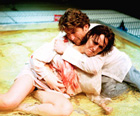
In any case, the play’s ending was interesting, with Medea coquettishly
flicking bloodstained water at Jason. A reconciliation in the offing?
Sensual love more powerful than maternal love? One was left uncertain,
feeling teased, irritated, aroused, but unfulfilled. Catharsis and closure
had not occurred.
The New York Times and Newsday gave this play favourable reviews, but
the critical reaction to the original UK production was mixed. One critic
for the Independent called the production “somewhat uneven”; another found
it “marvellous” and “unforgettable.” The Daily Mail liked it. The Guardian
complained that “the production's downbeat realism and exploration of
Medea's muddled motives sit oddly with its indulgence of emotional rant.”
The Telegraph groaned: “this is a production that robs Euripides of both
poetry and any sense of classical restraint and decorum [...] It's noisily
impressive and emotionally ugly, but strangely unmoving, because the performance
is so showy.” The Express regretted “a chorus dressed in EastEnders costumes,
an excess of grunge music and a trendy building site of a set in director
Deborah Warner's production. Give me togas and marble columns any day.”
[Postscript: Deborah Warner's production of Medea was picked up by Broadway
and will begin an 84-performance limited run at the Brooks Atkinson Theatre,
New York, on December 4, 2002.]
> Brooklyn Academy of Music
[INDEX]

|
|
|