|
|
|
[INDEX]
|
CD Reviews: Domingo's Wagner,
Kasarova's French Arias, Handel's Hercules, Offenbach's Hoffman,
Alvarez's French Arias, Mattila's German Arias, Cura's Boleros.
By Philip Anson / June 1, 2002
On the Aisle |  |
 Scenes
from Der Ring des Nibelungen Scenes
from Der Ring des Nibelungen
Pappano/Orchestra of the Royal Opera House Covent Garden
EMI 724355724229 (69.55)
5 stars $$$
Sexagenarian Placido Domingo is the leading Die Walküre Siegmund of our
day but he has never tackled Siegfried on stage, so this album of bleeding
chunks from Siegfried and Götterdämmerung fills a gap. Predictably, Domingo
is pushed to his limits by Siegfried’s high tessitura, but he is amazingly
game, delivering plenty of thrills. His work on this studio recording
(made at the Watford Coliseum in July 2001) is faithful to his style in
the opera house, including slightly mushy diction and ardent, baritonal
timbre. The sword-forging scene from Siegfried Act 1, Scene 3 is propulsive
and exciting. Domingo interacts well with tenor David Cangelosi’s crisply
defined, sneaky Mime. The less taxing Forest Murmurs monologue (Act 2,
Scene 2) showcases Domingo’s declamatory skills. French soprano Nathalie
Dessay’s Woodbird is a slight disappointment, sounding strangely distant.
In the Götterdämmerung excerpts the Brünhilde is Lithuanian mezzo Violetta
Urmana, a worthy artist who is - predictably - challenged to reach the
upper soprano range. The Orchestra of the Royal Opera Covent Garden under
their incoming music director Antonio Pappano plays with spirit and sweep
in Siegfried’s Rhine Journey and Funeral March, helped by the sorcery
of EMI’s engineers. The recorded sound is marvellously clear, detailed,
alive and atmospheric. The only flaw is some grunting and thumping, presumably
from the conductor. Notes and texts in English, French, and German.
 Vesselina
Kasarova: French Opera Arias Vesselina
Kasarova: French Opera Arias
Chaslin/Munich Radio Symphony
RCA 724321-676672 (53.40)
3 stars $$$
Bulgarian mezzo Vesselina Kasarova is a big star in Europe but Americans
are still wondering what the fuss is about. By all accounts, she is a
dynamic presence on stage, but her voice is full of peculiarities, with
a clarinettish timbre and a dramatic vibrato that won’t be to everyone’s
taste. Her upper range is more tight and hard-edged than her middle voice.
Her French vowels are approximate. She sounds best in the florid coloratura
arias from pants parts like Urbain (Les Huguenots) and Stefano (Romeo
et Juliette) and in dramatic roles like Dalila (Samson et Dalila) and
Margared (Le Roi d’Ys). In slower, lyrical arias her voice lacks emotion
and urgency. The arias on this French album are almost all melancholy,
which leads to monotony. The Munich Radio Symphony Orchestra under Frederic
Chaslin gives good support.
 Handel:
Hercules Handel:
Hercules
Minkowski/Les Musiciens du Louvre
Archiv DG 469 532 2 (3 CD - 175.69)
4 stars $$$
Minkowski has another winner with this first complete recording of Handel’s
“musical drama” Hercules (1744), taped by Radio France during a live performance
at the Theatre de Poissy (France) in April 2000. The libretto by Thomas
Broughton is drawn from Ovid’s Metamorphoses and Sophocles’ Trachininais.
Hercules is a serious work, like an oratorio in pace, with da capo arias
and choral closures to each act. It offers more drama and melody than
coloratura fireworks. As Dejanira, Swedish mezzo Anne Sofie von Otter
offers exquisite interpretations that sometimes shade away to wan nothingness
(“There in myrtle shades”). American countertenor David Daniels is superb
as Lichas. Tenor Richard Croft is good as Hyllus, Lynne Dawson as Iole.
Les Musiciens du Louvre under Marc Minkowski play with their usual pointed
brilliance. Notes and libretto in English, French and German.
 Offenbach:
Les Contes d’Hoffman Offenbach:
Les Contes d’Hoffman
Rudel/London Symphony Orchestra
Westminster/Universal 289 471 2472 (2 CDE-149.27)
5 stars $$$
The reissue of this classic, exciting 1972 Westminster recording Offenbach’s
Les Contes d’Hoffman is most welcome. The cast includes New York City
Opera stars of yesteryear Beverly Sills and Norman Treigle under conductor
Julius Rudel. Soprano Sills is impressive, with good high notes though
her trill is a bit loose and her acting can seem blowsy. The great bass
Norman Treigle is menacing and riveting as the villains, though his French
vowels are approximate. Tenor Stuart Burrows (Hoffman) is an excellent
singing actor with a graceful voice. The London Symphony Orchestra plays
masterfully. Digitally remastered from the original masters, the sound
is vivid, spacious and three-dimensional. If you had to have only one
Hoffman recording, this could be it.
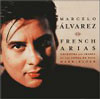 Marcelo
Alvarez: French Arias Marcelo
Alvarez: French Arias
Elder / Orchestre Philharmonique de Nice
Sony SK 89650 (67.43)
5 stars $$$
Young Argentinian tenor Marcelo Alvarez is one of a promising new crop
of Hispanic tenors, including Mexican Ramon Vargas, Argentinian Jose Cura,
and Peruvian Juan Diego Florez. This new album of French opera arias is
his third Sony recording following an album of Bel Canto and one of music
by Gardel. Alvarez has a virile, full, natural tenor sound that is somewhat
reminiscent of Domingo’s. At best he can sound as thrilling as Carreras
in his prime. The popular repertoire aims to please: “Pourquoi me reveiller”
from Massenet’s Werther, “Ah! Leve-toi soleil” from Gounod’s Roméo et
Juliette, “Ah, fuyez, douce image” from Massenet’s Manon, “Salut! Demeure
chaste et pure” from Gounod’s Faust, as well as less familiar offering
from Donizetti’s Dom Sébastien and Rossini’s “Guillaume Tell.” The vocalism
is everywhere arresting. “O dieu, de quelle ivresse” from Les Contes d’Hoffman
is highly charged. The five or so high C’s in “Ah, mes amis” from La Fille
du Regiment may not sound as easy as did the early Pavarotti’s, but they
are respectable. The sound of the recording (made in February-March 2001)
is full and satisfying. The Orchestre Philharmonique de Nice is clearly
boosted to push this shamelessly exciting album over the top. Good notes
by Martin Hoyle and Albert Innaurato. Texts in French and English. The
only flaw in this album is the muttering of what sounds like the conductor
or a prompter on tracks three and four. Otherwise, highly recommended.
 Karita
Mattila: German Romantic Arias Karita
Mattila: German Romantic Arias
Sir Colin Davis / Staatskapelle Dresden
Erato 0927-421412 (62’15)
2 stars $$$
Finnish soprano Karita Mattila is a big star in Europe. She is a big-boned
blond with commanding presence and a strong operatic voice. This is her
third solo CD following an album of show tunes called Wonderful (Ondine)
and Strauss’s Four Last Songs on DG. I’ve heard Mattila singing Mozart
in Salzburg and Beethoven at the Metropolitan Opera and I don’t get what
the excitement’s about. This disc is no help. The program of lamentatious
arias from the first half of the 19th-century includes familiar stuff
like Beethoven’s “Abscheulicher!” (from Fidelio), Weber’s “Leise, leise”
(from Der Freischütz) and “Ocean thou mighty monster” (from Oberon), plus
rarer stuff - two Euryanthe arias, Beethoven’s “Ah! Perfido” and Mendelssohn’s
“Infelice!” Mattila’s middle voice can be arrestingly pretty - as in the
beginning of “Und ob die Wolke” from Der Freischütz. But most of her singing
sounds charmless and unnaturally forced to me. The bel cantoish lines
of “Ah! Perfido” are heavy and uneasy, the Euryanthe arias harsh. Even
her dramatic soprano top, which should be the sine qua non of her fach
and career, comes across as unpleasantly hard, more like a cry than a
lyrical outpouring, overstepping the boundary between music and noise.
This could never be said of the plush, voluptuous, easily floated sound
of Debby Voigt who sings much of this same rep today. Or Birgit Nilsson,
whose recordings of most of this rep are definitive and preferable to
Mattila’s. Sir Colin Davis’s slow tempi would be right for a singer who
had a prettier voice, but here they just prolong the agony.
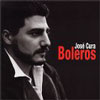 José
Cura: Boleros José
Cura: Boleros
Warner 857385821 2
1 star $$$
Opera lovers should beware Argentinian tenor José Cura’s latest crossover
venture. Boleros offers twelve latin lovesongs aimed at the same suburban
housewife crowd that buys Andrea Bocelli, Russell Watson, Charlotte Church
and other novelty acts. These schmaltzy, hairy-chested lounge songs are
overorchestrated by Muzak and soundtrack masters Ettore Stratta and Jorge
Calandrelli. The liner notes claim this music is the equivalent of American
jazz ballads but Cura here sounds like a hispanic Tom Jones or Tony Bennet.
[INDEX]

|
|
|