|
|
|
[INDEX]
The Chicago Symphony Orchestra’s three-concert Wagner and Modernism triptych
at Carnegie Hall (all conducted by Daniel Barenboim) ended on Oct. 20
with a galvanizing recital of Wagner’s opera Tristan und Isolde. The sterling
cast was led by German soprano Waltraud Meier, a red-headed beauty with
great acting skills and a remarkable voice that make her one of our Wagneriennes
of choice. Originally a mezzo, Meier has moved into soprano territory
and sang one of her first Isoldes in 1993 at Bayreuth under Daniel Barenboim.
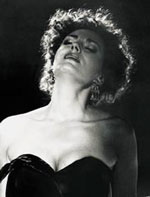 Meier
is not a “stand and sing” Isolde. She is a subtle actress, signalling
moods and reactions with gestures as small as an arched eyebrow and a
tilt of the head. Meier played Isolde as a politically savvy young lady
full of aristocratic dignity, but also perilously vulnerable to her unfledged
emotions. Meier wore a different dress color-coded to the emotional atmosphere
of each act: neutral blue for Act I, hot crimson for the passionate Act
II, and funereal black for the tragic Act III. This theatrical touch focused
the attention on Isolde, where it belongs. She was totally inside her
part and didn’t use a score. Meier
is not a “stand and sing” Isolde. She is a subtle actress, signalling
moods and reactions with gestures as small as an arched eyebrow and a
tilt of the head. Meier played Isolde as a politically savvy young lady
full of aristocratic dignity, but also perilously vulnerable to her unfledged
emotions. Meier wore a different dress color-coded to the emotional atmosphere
of each act: neutral blue for Act I, hot crimson for the passionate Act
II, and funereal black for the tragic Act III. This theatrical touch focused
the attention on Isolde, where it belongs. She was totally inside her
part and didn’t use a score.
Tristan was sung by German Heldentenor Christian Franz, who is touted
as the next big thing at Bayreuth. The 40ish singer has a clear, metallic
voice of adequate power, focus, expressivity, and stamina. His instrument
is smaller and less warm than that of Domingo or Heppner, but is probably
well-suited to modest-sized European opera houses. He doesn’t have great
top notes either - but then who does? His main asset seems to be stamina,
the accurate diction of a native speaker, and an honest, natural sound.
Physically he is short, stout, and unprepossessing. His acting was nonexistent
compared to Meier.
Brangäne was sung by German mezzo Nadja Michael, a tall, striking looking
beauty with the body of a Giacometti and the head of a Brancusi. From
her slender supermodel body (wrapped in a white silk shift) emerged a
huge, high mezzo voice that had no trouble riding the orchestra and keeping
pace with Meier and Franz. I prefer a more maternal, contraltoish Brangäne,
but Michael was acceptable. Her only problem was a brief coughing attack
during her watch song, no doubt caused by the very dry air.
As King Mark, the deep, plummy-voiced English bass John Tomlinson gave
a brilliantly intense performance, especially in his Act II Scene III
betrayal monologue. The rest of the cast (Andreas Schmidt as Kurwenal,
Brian Davis as Melot, Marcel Reijans as the Sailor) and members of the
Concert Chorale of New York offered adequate support.
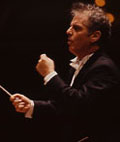 The
Chicago Symphony Orchestra played with confidence, passion and power,
no doubt because they were still warmed up from their Oct. 13 and Oct.
16 Chicago performances. The
Chicago Symphony Orchestra played with confidence, passion and power,
no doubt because they were still warmed up from their Oct. 13 and Oct.
16 Chicago performances.
Altogether this was a thrillingly sung, dramatically riveting performance
that did not suffer by the elimination of the $200,000 worth of originally
planned lighting, staging, and design elements. Meier, Franz, Michael,
and Tomlinson are all first-class singers who physically look the parts
they play. For opera fans who demand visual verisimilitude, these thin
Europeans were a welcome change from the usual overweight Wagnerians served
up by the Metropolitan Opera.
The other two Chicago Symphony Orchestra concerts this week were a mixed
success.
The Oct. 18 concert opened with Max Bruch’s haunting Kol Nidrei dedicated
to the memory of the late violinist and Carnegie Hall saviour Isaac Stern.
The Chicago Symphony Orchestra had originally programmed the Prelude to
Wagner's Die Meistersinger for this program, which they were suppose to
play on Sept. 27 as part of their regular Chicago season. But since that
day was the Jewish holiday of Yom Kippur, and Stern died on Sept. 22,
the anti-semitic Wagner was replaced by Bruch’s lovely Hebrew melodies.
 Cellist
Yo-Yo Ma played the wrenchingly sad work beautifully, provoking a spate
of sobs and sniffles. Then came something completely different, the New
York premiere of Elliott Carter’s Cello Concerto (which had its world
premiere in Chicago on Sept. 27), commissioned by the Chicago Symphony
Orchestra and played by Ma. Carter wrote the work for Ma in recognition
of Ma’s performance of Carter’s Cello Sonata with pianist Barenboim last
year. The concerto is typical Carter, as intellectually diffuse and evasive
as the Bruch had been emotionally direct and engaging. Carter’s eclectic
formalism - the disjunctive percussion and the ironic sputtering cello
line - sounded obtuse and felt long at 20 minutes. The spry, 92-year old
composer took several bows. After the intermission the orchestra played
excerpts from Wagner’s Götterdämmerung: Dawn and Siegfried’s Rhine Journey.
Siegfried’s Death and Funeral Music, and Epilogue. It was frankly routine
playing. Soprano Elizabeth Connell sounded overtaxed in Brunnhilde’s Immolation
Scene. Cellist
Yo-Yo Ma played the wrenchingly sad work beautifully, provoking a spate
of sobs and sniffles. Then came something completely different, the New
York premiere of Elliott Carter’s Cello Concerto (which had its world
premiere in Chicago on Sept. 27), commissioned by the Chicago Symphony
Orchestra and played by Ma. Carter wrote the work for Ma in recognition
of Ma’s performance of Carter’s Cello Sonata with pianist Barenboim last
year. The concerto is typical Carter, as intellectually diffuse and evasive
as the Bruch had been emotionally direct and engaging. Carter’s eclectic
formalism - the disjunctive percussion and the ironic sputtering cello
line - sounded obtuse and felt long at 20 minutes. The spry, 92-year old
composer took several bows. After the intermission the orchestra played
excerpts from Wagner’s Götterdämmerung: Dawn and Siegfried’s Rhine Journey.
Siegfried’s Death and Funeral Music, and Epilogue. It was frankly routine
playing. Soprano Elizabeth Connell sounded overtaxed in Brunnhilde’s Immolation
Scene.
The Oct. 19 concert opened with another New York premiere, German composer
Isabel Mundry’s 15-minute mini-piano concerto Panorama ciego (2001), inspired
by Garcia Lorca’s poetry and commissioned by the Chicago Symphony Orchestra
and Berlin Symphony Orchestra. Barenboim introduced the work and then
played the piano part. Mundry is a psychologically bold colorist, the
musical counterpart of modern painters like Mark Rothko, Franz Kline,
and Motherwell. With almost Buddhist reserve, she conjures elementally
simple floes of sound, ribbons of tone from the single instruments. Sustained
notes acquire the complexity of busy passages. The simple lapidary juxtaposition
of oboe and clarinet tones and the faint rumble of timpani seemed profound
compared to Elliott Carter’s noisy business the day before. Mundry’s music
sets a mood and stimulates reflection. The young woman took a well-deserved
bow.
After the intermission we were treated to the first act of Die Walküre.
German tenor Peter Seiffert was the ardent Siegmund. His Winterstürme
was accurate but not very moving. German soprano Angela Denoke’s Sieglinde
was feminine, engaging and credible. She deployed a nice big voice and
finely shaped cantilena phrasing in “Der Männer Sippe”. Bass John Tomlinson
was a suitably menacing Hunding. Denoke and Tomlinson knew their parts
by heart; Seiffert occasionally checked his score. Barenboim led a competent
but uninspired reading, without great passion or poetry. The orchestra
seemed to be saving itself for the next day’s Tristan und Isolde.
Carnegie Hall was almost full for Tristan but the exorbitant $170 top
ticket price - more than the top Metropolitan Opera ticket price - meant
that several dozen empty seats were filled at the last minute by a motley
crew of senior citizen and local music students.
In the past I have been critical of Barenboim’s Chicago Symphony Orchestra,
but this Wagner mini-series (costing over $1 million according to the
Chicago Tribune) proves that when the CSO thinks big it can achieve marvels.
The CSO’s current financial troubles (it recently lost its national syndicated
radio broadcast series, its recording contract with Teldec, and posted
a US $1.3 million deficit for fiscal 2001) will mean fewer such adventures,
and that’s a shame. America’s musical scene will be poorer for it.
> Carnegie Hall
> Chicago Symphony Orchestra
> Waltraud Meier Website
[INDEX] |
|
|