|
|
|
[INDEX]
 It
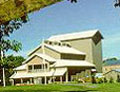
is always a pleasure to visit Glimmerglass Opera, a gem of a company which
presents four new, sometimes scrumptious, productions every summer in
pastoral upstate New York. This was my seventh summer reviewing the offerings.
I found the pioneering spirit vibrant and the artistic magic undimmed. It
is always a pleasure to visit Glimmerglass Opera, a gem of a company which
presents four new, sometimes scrumptious, productions every summer in
pastoral upstate New York. This was my seventh summer reviewing the offerings.
I found the pioneering spirit vibrant and the artistic magic undimmed.
As usual, this year’s quartet offered something for everyone, from Handel's
tragicomedy Agrippina and Britten's chilling The Rape of Lucretia, to
Mozart's bittersweet Le nozze di Figaro and Chabrier's fluffy opera bouffe
L'étoile. Each production had its strengths and weaknesses. Taken together
they provided a rich and satisfying musical-theater experience.
The strongest and most serious of the offerings was Benjamin Britten’s
Rape of Lucretia (seen August 17), a stark, stylized drama that mesmerizes
the listener through the bardic libretto by Ronald Duncan, and Britten’s
psychologically foreboding, repetitive orchestration. The story is simple:
the Etruscan Prince Tarquinius (Nathan Gunn) rapes the virtuous Roman
matron Lucretia (Michelle DeYoung) to satisfy his lust and humiliate her
husband Collatinus (Eric Owens). The Male Chorus (William Burden) and
Female Chorus (Christine Goerke) lurk on the sidelines speculating on
the metaphysical implications of the historical actions.
The singers were all strong: Gunn’s butch baritone, Goerke’s barely domesticated
dramatic soprano, Burden’s ardent but sometimes strained tenor, and DeYoung’s
large but not especially plush high mezzo. More could have been made of
these artists, but their acting was hampered by Christopher Alden’s catatonic
direction blocked out amid Paul Steinberg’s sets, which recalled dreary
post-war Britain circa-1950. Mr. and Mrs. Chorus were a drab pair of couch
potatoes, knitting and reading the newspaper as they sang. DeYoung’s Lucretia
was a solemn hausfrau who dragged around a light fixture with a long cord
that threatened to trip everyone before she changed into a Jackie-O dress
and pillbox hat for her suicide. Hunky Nathan Gunn (who titillated Glimmerglass
as a barechested Oreste in Gluck’s Iphigenie en Tauride four years ago)
did a credible Russell Crowe-Stanley Kowalski imitation this time around.
The only problem with Gunn’s brooding, unshaven, eminently doable Tarquinius
is that he was so hot that Lucretia’s virtuousness made no sense. Alas,
the supposedly climactic violation of the title was reduced to an awkward
clinch on the sofa - The Hug of Lucretia. At least the orchestra under
Stewart Robertson was passionate, with excellent harp and woodwind solos.
 More
dramatic fire was generated in Handel’s Agrippina thanks to African-American
bass-baritone Derrick Parker who was totally credible as the womanizing
Emperor Claudio. He had a rich, deep voice and radiated physical confidence.
Californian soprano Alexandra Coku played Agrippina as a scheming, Joan
Collinsish bitch. She has the look down pat but her voice was not perfectly
suited to Handel’s idiom. Canadian soprano Karen Wierzba was more successful
as a dumb-as-a-fox Poppea who wrapped all the men around her little finger.
Wierzba has a truly pleasant voice and good technique. Her plump, blond
beauty was a strikingly effective contrast to her lover, the ebony Claudio.
American mezzo Beth Clayton’s Nerone was unfortunately caricatural. Pants
parts are difficult to play, but Clayton looked unconvinced and unconvincing
- more dykey than mannish or boyish. Nerone has many of the opera’s great
arias but unfortunately Clayton’s singing was merely serviceable. Argentinean
director Lillian Groag did a good job of traffic control, but having Nerone
flic his Bic throughout the show was crass (alright already, we know he
torched Rome). The weakest links in the cast were the two countertenors.
Chubby Michael Maniaci was a funny actor as Narciso but his faint, toneless
male soprano is not of opera quality. Company fixture David Walker was
a major disappointment in the important role of Ottone. Walker has done
well in previous Glimmerglass / New York City Opera productions, but on
August 19 he was off pitch almost all the time and had great difficulty
supporting his line. This ruined the opera’s best arias. Lets hope he
gets well soon. The sets by John Conklin featured predictable chunks of
classical architectural mouldings, capitols, and big sculptures of Roman
heads. Harry Bicket conducted with considerable elan. This production
opens at the New York City Opera on April 7, 2002. More
dramatic fire was generated in Handel’s Agrippina thanks to African-American
bass-baritone Derrick Parker who was totally credible as the womanizing
Emperor Claudio. He had a rich, deep voice and radiated physical confidence.
Californian soprano Alexandra Coku played Agrippina as a scheming, Joan
Collinsish bitch. She has the look down pat but her voice was not perfectly
suited to Handel’s idiom. Canadian soprano Karen Wierzba was more successful
as a dumb-as-a-fox Poppea who wrapped all the men around her little finger.
Wierzba has a truly pleasant voice and good technique. Her plump, blond
beauty was a strikingly effective contrast to her lover, the ebony Claudio.
American mezzo Beth Clayton’s Nerone was unfortunately caricatural. Pants
parts are difficult to play, but Clayton looked unconvinced and unconvincing
- more dykey than mannish or boyish. Nerone has many of the opera’s great
arias but unfortunately Clayton’s singing was merely serviceable. Argentinean
director Lillian Groag did a good job of traffic control, but having Nerone
flic his Bic throughout the show was crass (alright already, we know he
torched Rome). The weakest links in the cast were the two countertenors.
Chubby Michael Maniaci was a funny actor as Narciso but his faint, toneless
male soprano is not of opera quality. Company fixture David Walker was
a major disappointment in the important role of Ottone. Walker has done
well in previous Glimmerglass / New York City Opera productions, but on
August 19 he was off pitch almost all the time and had great difficulty
supporting his line. This ruined the opera’s best arias. Lets hope he
gets well soon. The sets by John Conklin featured predictable chunks of
classical architectural mouldings, capitols, and big sculptures of Roman
heads. Harry Bicket conducted with considerable elan. This production
opens at the New York City Opera on April 7, 2002.
Glimmerglass’s co-production (with Florida Grand Opera) of Le nozze di
Figaro was a bold effort that didn’t quite gel. The singers were all young
and enthusiastic. Dean Ely’s Figaro was smart, good looking, and nicely
sung. The star of the show was Illinois soprano Nicole Heaston, who had
the best voice of the season. Her singing was warm and professional, a
pleasure to hear, and she was a pert, natural actress. Christopher Schaldenbrand
as Count Almaviva was hampered by director Stephen Lawless’s conception
of him as a sort of effeminate ponce. Joyce Guyer as the Countess was
stately but her singing was dull. Key arias like Porgi amor left one unmoved.
Her Schwarzkopf-Marschallin blue and white ball gown was gorgeous, but
the dress does not make the diva. Valerie Komar, a member of the Young
American Artist program, was a vivacious Cherubino. Costumes by Johann
Stegmeir were marred by emblems of each character’s profession (a book
for Bartolo, a fiddle for Basilio) stuck on their shoulders. The set by
Belgian Benoit Dugardyn was cheap and semi-realistic, transformed from
scene to scene by moveable walls and pillars. Sets and costumes of this
sort may satisfy the provincial Florida Grand Opera, Florentine Opera,
and the Opera de Montreal but they fall short of Glimmerglass’s usual
sophisticated standards. Conducting by George Manahan was top notch.
The undisputed best production of the summer was Chabrier’s L’etoile (seen
Aug. 18) with brilliant sets by Andrew Liebermann and riotous costumes
by Constance Hoffman. Chabrier’s fluffy opera bouffe is so trivial and
zany it seems almost improvised on the spot. The plot - involving the
preposterous King Ouf’s need for a human sacrifice to cheer up his birthday,
but then finding that his victim’s life is linked to his own by astrological
fate - is little more than an excuse for a string of droll arias, sentimental
ballads, and frantic choruses. Truth be told, the libretto is inferior
to anything by Offenbach or Gilbert and Sullivan. But the bright, brash,
incredibly witty postmodern Liebermann-Hoffman production redeems all
(no surprise that Opera de Montreal staff were at Glimmerglass to see
if this show might be exported to Montreal). The high tech, slick plastic
walls are a mass of spying eyes, the characters dash about on Jetson scooters,
and the chorus dances to disco strobes. The cast, largely Young Artists,
sang and acted with panache. Ouf stalks about in a huge fur coat like
an Edward Gorey cartoon (he was superbly played by Torrance Blaisdell,
a magnetic, Dom Delouise type actor.) Ouf’s victim Lazuli was well sung
and even better acted by waifish mezzo Christine Abraham. His lover Laoula
was very well sung and acted by Canadian soprano Karina Gauvin. Direction
by Mark Lamos and choreography by Seán Curran was masterful. What a pity
Glimmerglass performed this opera in an English translation by Jeremy
Sams. Nothing was gained, while all the flavour and verbal humour of the
French was lost. The surtitles were still necessary to understand the
English, and the cast had no trouble singing the occasional French verse
- which sounded wonderful. Lets hope Glimmerglass abandons this misguided
policy before their Dialogues des Carmelites next year.
The 2002 Glimmerglass season will feature Cav and Pag with the wonderful
Hawaiian tenor Keith Ikaia-Purdy, Mark Adamo’s Little Women, Haydn’s Orlando
Paladino, and Poulenc’s Dialogues des Carmelites (in English, alas!).
> New York City Opera
> Glimmerglass Opera
[INDEX] |
|
|