|
|
|
[INDEX]
Wilson’s Dream Play: A Divine Tragicomedy
By Philip Anson / November 28, 2000
On the Aisle |  |
 Thank
goodness for the Brooklyn Academy of Music (BAM). Time and again its Next
Wave Festival (a moveable feast of the world’s best dance, opera, and
performance art) proves itself one of America’s last bastions of high-class,
forward-looking artistic performance. Its latest triumphant offering is
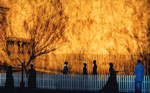
Robert Wilson’s staging of August Strindberg’s A Dream Play (1901) with
Stockholm's Stadsteater. This gorgeous, thought-provoking production finally
made its US debut this autumn after touring France and Australia, and
ran for four sold out nights. The show was so rich and complex, one wished
to return again and again, in order to unpack its ambiguities and to savour
again its visually seductive atmosphere. Thank
goodness for the Brooklyn Academy of Music (BAM). Time and again its Next
Wave Festival (a moveable feast of the world’s best dance, opera, and
performance art) proves itself one of America’s last bastions of high-class,
forward-looking artistic performance. Its latest triumphant offering is
Robert Wilson’s staging of August Strindberg’s A Dream Play (1901) with
Stockholm's Stadsteater. This gorgeous, thought-provoking production finally
made its US debut this autumn after touring France and Australia, and
ran for four sold out nights. The show was so rich and complex, one wished
to return again and again, in order to unpack its ambiguities and to savour
again its visually seductive atmosphere.
Wilson’s style is by now well-known from his work in opera and the so-called
straight theater: stylized choreography drawing on T’ai Chi and other
martial arts; androgynous Japanesey costumes; and vibrant swaths of color
that almost become protagonists themselves. In the past, Wilson’s aesthetic
has been known to clash with the naturalistic bias of his material, such
as when he staged Wagner’s Lohengrin at the Metropolitan Opera. But in
this case, Wilson and Strindberg are a natural fit.
The fragmented narrative of A Dream Play revolves around a Hindu goddess’s
visit to earth, and her exploration of human joy and misery. According
to Strindberg, the play attempts “to imitate the inconsequent yet transparently
logical shape of a dream. Everything can happen, everything is possible
and probable. Time and place do not exist; on an insignificant basis of
reality , the imagination spins, weaving new patterns; a mixture of memories,
experiences, free fancies, incongruities and improvisations. The characters
split, double, multiply, evaporate, condense, disperse, assemble.” Wilson
sticks to single, recognizable characters who offer some semblance of
narrative unity, but their behaviour is erratic -- sometimes spastic,
sometimes repetitive. A madhouse atmosphere hangs over the dream/nightmare.
Wilson’s bright colors, chic costumes, and obviously expensive sets belie
the drab puritanism of the Swedish setting. But they help sustain interest,
situating the drama outside economic and psychological realism. Somehow
Wilson’s dandyish aestheticism doesn’t trivialism this essentially serious
work. Though Strindberg’s play touches on weighty matters such as morality,
religion, sexuality, and the meaning of life, these kotty questions are
passively observed. As Strindberg says, he “neither acquits nor condemns,
but merely relates.” Of course, the basic atmosphere is hopeless, depressing,
and desperate. Strindberg’s bourgeois society is suffocating, brutal,
and senseless. Love and pleasure are eagerly sought, but reluctantly enjoyed
- poisoned gifts at best.
Wilson does nothing to soften this pessimism. He shocks us out of complacency
with unexpected sound effects (there are more than 400 computerized sound
cues), such as shattering glass and the sinister sound of distant bombs.
Synchronized with onstage movement, these sounds seem to be both cause
and effect of human movement, as in a dream. The bombs accompany a maid’s
steps on the beach. The shattering glass causes a moment of existential
panic, quickly erased. The audience becomes the guinea pig in a behavioural
study of high decibel stimulus. This dark absurdism is mixed with childishly
zany shtick, such as a Keystone Cops routine with prancing jockeys and
farmgirls milking plastic cows to a Warner Brothers cartoon sound track.
Still, Wilson’s comic relief never disguises Strindberg’s obsession with
“a ceaseless wavering between sensuality and the pangs of remorse” which
he called “the answer to the riddle of life.” No wonder that one of the
characters freezes into the pose of Edvard Munch’s famous painting The
Scream. The whole play could be interpreted as a preamble to that iconic
image.
The Swedish actors of the Stockholm Stadsteater were superb, totally engrossed
in their physically demanding roles. Jessica Liedberg as the Goddess (Agnes)
made nary a false step though she had the equivalent of a two-hour ballet
to dance, while reciting her lines. Astounding! The whole production,
with 13 set changes, was technically flawless.
Note: Film and theater director Ingmar Bergman brings his latest (fourth)
production of Strindberg’s Ghost Sonata (with the Royal Dramatic Theatre
of Sweden) to BAM from June 20-24, 2001.
Credits
August Strindberg: A Dream Play
Stockholm Stadsteater
Direction, design and lighting by Robert Wilson
Music by Michael Galasso
Costumes and masks by Jacques Reynaud
Lighting by Andreas Fuchs, Robert Wilson
Dramaturgy by Holm Keller, Monica Ohlsson
Sound by Ronald Hallgren
Performed in Swedish with English surtitles
> Brooklyn Academy of Music (BAM)
> More about Robert Wilson’s Dream Play
[INDEX] |
|
|